
Edmonton summer nights barely exist. When the sun sets after 10 PM and rises before 5 AM, your body gets confused. Those 17-hour days that make River Valley runs so appealing also wreak havoc on your sleep patterns. Why does Edmonton summer daylight affect sleep schedules so dramatically? The answer lies in your circadian rhythm and how extreme latitude affects your internal clock.
Last reviewed:
Living at 53.5 degrees north latitude means experiencing some of the longest summer days in Canada. While southern cities get maybe 15 hours of daylight, Edmonton pushes past 17 hours at the summer solstice. That extra light exposure fundamentally changes how your body produces melatonin, regulates temperature, and signals bedtime.
For more on this, see our prepare body edmonton guide.
The Science Behind Edmonton’s Extreme Summer Light
Edmonton sits farther north than London, Berlin, or Amsterdam. Our latitude creates dramatic seasonal light variations that southern Canadian cities never experience. During June and July, the sun barely dips below the horizon, creating extended twilight that keeps the sky bright until nearly midnight.
How Latitude Affects Daylight Hours
The Earth’s tilt creates our seasons, but latitude determines how extreme those seasonal changes become. Edmonton’s position means we experience:
How To Prevent Seasonal Wellness Routine Breakdowns In Edmonton covers this in more detail.
- 17 hours and 3 minutes of daylight on June 21st
- Sunrise as early as 5:04 AM in mid-June
- Sunset as late as 10:07 PM during summer solstice
- Civil twilight extending past 11 PM in June
- Only 5-6 hours of true darkness in midsummer
Compare that to Toronto’s mere 15.5 hours of summer daylight. Those extra 90 minutes make a massive difference to your sleep hormones. Health Canada’s guidance on light exposure notes that northern communities face unique challenges managing circadian rhythms during extreme seasonal light variations.
Does Edmontons Long Summer Daylight Improve Mental Wellness covers this in more detail.
Understanding Circadian Rhythm Disruption
Your circadian rhythm runs on a roughly 24-hour cycle, controlled by light exposure to your eyes. Special cells in your retina detect blue light wavelengths and signal your brain’s master clock. When Edmonton summer daylight floods your bedroom at 5 AM and lingers past 10 PM, those signals get scrambled.
Edmonton Spring Allergies Wellness Guide For Seasonal Relief covers this in more detail.
The suprachiasmatic nucleus in your brain expects darkness to trigger melatonin production. But when bright light persists until late evening, melatonin release delays by hours. Many Edmontonians report not feeling sleepy until 1 or 2 AM during peak summer, then struggling to wake for work despite full daylight at 6 AM.
Melatonin Production in Extended Daylight
Melatonin, your sleep hormone, normally starts rising around 9 PM in response to darkness. But Edmonton’s summer light suppresses this natural process. Research from the University of Alberta’s sleep researchers shows that northern latitude residents produce melatonin 2-3 hours later during summer months compared to winter.
This delayed melatonin onset creates a cascade of problems:
- Body temperature stays improved past normal bedtime
- Cortisol levels remain high into late evening
- REM sleep phases shift later into the night
- Total sleep duration decreases by 1-2 hours on average
- Sleep quality diminishes even when duration seems adequate
Physical and Mental Health Impacts
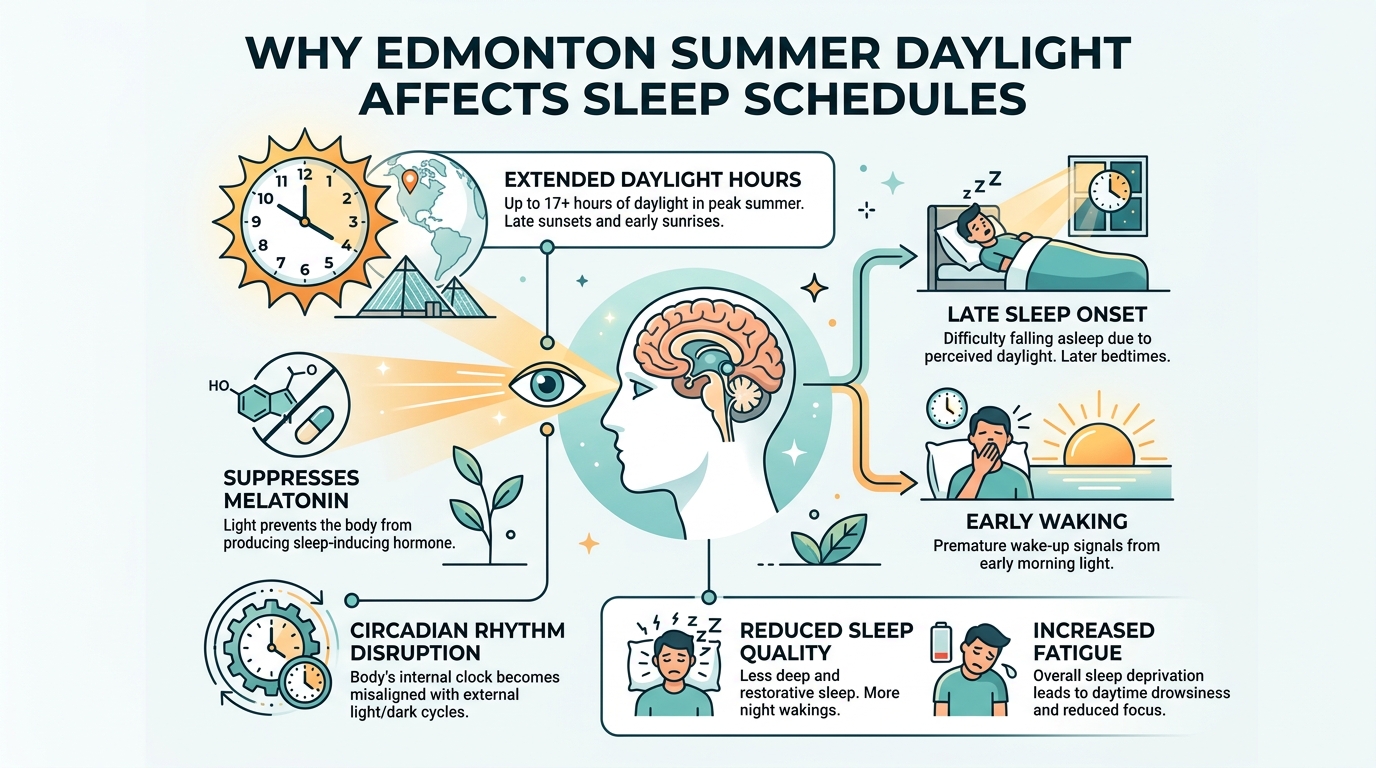
The question of why does Edmonton summer daylight affect sleep schedules extends beyond simple inconvenience. Chronic sleep disruption during our lengthy summer affects every system in your body. Local sleep clinics report a 40% increase in insomnia complaints between May and August.
Common Sleep Problems During Edmonton Summers
Sleep specialists at the Royal Alexandra Hospital’s sleep disorders clinic see predictable patterns each summer. Patients report:
- Delayed Sleep Phase Syndrome: Can’t fall asleep before 2-3 AM despite exhaustion
- Early Morning Awakening: Bright light at 5 AM triggers premature waking
- Fragmented Sleep: Multiple awakenings throughout the short night
- Non-Restorative Sleep: Feeling unrefreshed despite 7-8 hours in bed
- Daytime Fatigue: Persistent tiredness despite adequate caffeine intake
These disruptions compound over weeks. By late July, many Edmontonians operate in a state of chronic sleep debt that affects work performance, mood, and physical health.
Impact on Energy and Mood
Sleep deprivation hits hard when you’re trying to enjoy Edmonton’s brief summer. The irony? Perfect weather for Hawrelak Park picnics or Folk Music Festival, but you’re too tired to fully participate. Studies show that losing just one hour of sleep nightly for a week equals pulling an all-nighter in terms of cognitive impairment.
Mental health professionals across Edmonton note increased anxiety and irritability during summer months. The combination of sleep loss and social pressure to maximize outdoor time creates a perfect storm. You feel guilty sleeping in when the sun’s shining, but exhausted from late nights under bright skies.
Local psychologists recommend acknowledging this unique Edmonton challenge. Understanding why does Edmonton summer daylight affect sleep schedules helps normalize the struggle and motivate proper sleep hygiene practices.
Long-Term Health Consequences
Chronic summer sleep disruption affects more than daily energy. Alberta Health Services warns that persistent sleep loss increases risk for:
- Type 2 diabetes (insulin sensitivity drops with poor sleep)
- Cardiovascular disease (blood pressure rises without adequate rest)
- Weight gain (hunger hormones dysregulate with sleep loss)
- Weakened immunity (T-cell function decreases)
- Accelerated aging (cellular repair happens during deep sleep)
For shift workers at refineries or hospitals, Edmonton’s summer light compounds existing circadian challenges. Night shift nurses report particular difficulty sleeping during daylight hours when blackout solutions prove inadequate against our intense summer sun.
Environmental Factors Unique to Edmonton

Beyond raw daylight hours, Edmonton’s summer environment creates additional sleep challenges. Our northern prairie location means intense, angled sunlight that penetrates standard window coverings. Combined with our architectural trends and urban layout, sleep disruption becomes almost inevitable without intervention.
Light Pollution in Different Neighborhoods
Light pollution varies dramatically across Edmonton neighborhoods. Downtown and Oliver residents face double challenges: extended natural daylight plus intense urban lighting. The Ice District’s LED displays and Jasper Avenue’s streetlights create an artificial dawn that never fully darkens.
Neighborhood-specific challenges include:
- Downtown: Rogers Place area stays bright 24/7, high-rise reflections amplify morning sun
- Whyte Avenue: Bar district lighting plus early morning street cleaning disrupts sleep
- Oliver: Dense housing means neighbors’ lights affect your darkness levels
- Windermere: Newer LED street lighting creates harsh blue-spectrum pollution
- Mill Woods: Wide streets and sparse tree cover mean less natural shading
River Valley communities like Riverdale or Cloverdale enjoy more tree cover, naturally filtering morning light. But even these areas struggle with Edmonton’s extreme sun angles that find gaps in any shading.
Temperature and Humidity Challenges
Edmonton summers bring another sleep disruptor: heat without humidity. Our dry prairie air means temperatures swing dramatically between day and night. A 30°C afternoon might drop to 12°C by dawn, but your bedroom stays warm without proper ventilation.
Most Edmonton homes lack air conditioning, relying on open windows for cooling. This creates a dilemma: keep windows closed for darkness but suffer heat, or open them for air but let in light and noise. The 5 AM sunrise streaming through open windows guarantees early waking.
Basement suites offer natural cooling but often have small windows that still admit surprising amounts of angled summer light. Upper floor apartments in older buildings become heat traps, with temperatures remaining above comfortable sleeping range until well past midnight.
Noise Levels During Extended Daylight
Long daylight hours mean extended activity periods across the city. Construction crews start at 7 AM when it’s been light for two hours already. Neighbors mow lawns until 9 PM because it still looks like afternoon. The general noise floor stays improved much later than in winter months.
Festival season compounds the issue. Folk Music Festival, Heritage Days, and K-Days generate noise well into night hours. Even residential areas experience more evening activity: kids playing street hockey until 10 PM, backyard gatherings lasting past midnight, early morning joggers hitting River Valley trails by 5:30 AM.
Practical Solutions for Better Summer Sleep
Understanding why does Edmonton summer daylight affect sleep schedules leads naturally to solutions. Edmonton wellness practitioners have developed specific strategies for our unique latitude challenges. These aren’t generic sleep tips – they’re designed for our 17-hour summer days.
Bedroom Modifications for Light Control
Standard curtains won’t cut it in Edmonton summers. You need military-grade light blocking to simulate darkness. Local window covering specialists recommend:
- Cellular blackout shades with side channels (eliminates light gaps)
- Blackout curtains hung 6 inches wider than window frame
- Aluminum foil or blackout film for complete light elimination
- Draft stoppers under doors to block hallway light
- Eye masks as backup when traveling or visiting
Budget option: Local hardware stores sell blackout fabric by the meter. Create DIY window inserts using cardboard and blackout material for under $20 per window. Many University of Alberta students swear by this method for dorm rooms.
Consider room orientation when possible. North-facing bedrooms in Edmonton receive less direct summer sun. If you’re apartment hunting during summer, prioritize units where bedrooms face north or have minimal eastern exposure.
Sleep Hygiene Adjustments for Long Days
Generic sleep hygiene advice assumes normal daylight patterns. Edmonton summers require modified approaches:
| Standard Advice | Edmonton Summer Modification |
|---|---|
| Avoid screens 1 hour before bed | Start screen curfew at 8 PM despite full daylight |
| Keep bedroom cool | Use fans starting at 7 PM to pre-cool room before outdoor temps drop |
| Consistent bedtime | Maintain winter bedtime despite light, use alarms for routine |
| Morning light exposure | Delay intentional light exposure until after 7 AM |
| Exercise regularly | Complete workouts before 6 PM to allow cooldown time |
Create artificial evening starting at 8 PM. Close blinds, dim house lights, and begin bedtime routines despite outdoor brightness. This trains your circadian rhythm to ignore external light cues.
Technology and Tools for Edmonton Sleepers
Modern technology offers solutions specifically helpful for extreme latitude living. Edmonton sleep specialists recommend:
- Smart bulbs programmed to dim gradually starting at 8 PM
- White noise machines to mask extended evening activity sounds
- Sleep tracking apps to identify patterns and optimize timing
- Blue light blocking glasses worn from 7 PM onward
- Sunrise alarm clocks set to winter timing despite natural light
Local stores like London Drugs on Jasper Avenue or Memory Express carry specialized sleep tech. Staff report massive sales increases each May as Edmontonians gear up for summer sleep challenges.
Several Edmonton-based apps now include “summer sleep mode” with adjusted recommendations for our latitude. The University of Alberta’s computing science students developed a free circadian rhythm tracker specifically calibrated for Edmonton’s light patterns.
Professional Help and Local Resources
When DIY solutions fail, Edmonton offers specialized help for summer sleep issues. Our unique challenges mean local practitioners understand why does Edmonton summer daylight affect sleep schedules better than generic online advice ever could.
Sleep Clinics and Specialists in Edmonton
Several Edmonton clinics specialize in circadian rhythm disorders and seasonal sleep disruption:
- Covenant Health Sleep Centre (Grey Nuns Hospital): Full sleep studies, specializes in shift worker disorders
- MCI Sleep Clinic (Multiple locations): Offers cognitive behavioral therapy for insomnia
- Royal Alex Sleep Disorders Program: complete assessment for chronic sleep issues
- Kaye Edmonton Clinic: Integrates sleep medicine with mental health support
Wait times typically increase in June and July as sleep complaints spike. Book appointments in May if you struggled the previous summer. Most clinics offer specific “summer sleep” programs addressing our latitude-related challenges.
Private sleep consultants work from home visit models, assessing your specific bedroom setup and neighborhood light pollution. Prices range from $200-$400 for complete assessment and personalized plans. Insurance coverage varies – check your benefits for “sleep hygiene consultation” coverage.
Wellness Centers Offering Sleep Programs
Edmonton wellness centers increasingly recognize summer sleep as a distinct challenge requiring targeted intervention. Local wellness practitioners listed on Edmonton Wellness Guide offer various approaches:
- Elements Physical Therapy (Whyte Ave): Sleep positioning workshops for hot weather
- Float Wellness Centre (West Edmonton): Sensory deprivation helps reset circadian rhythms
- Bliss YogaSpa (St. Albert): Evening yin yoga classes designed for sleep preparation
- Kingsway Wellness: Acupuncture protocols specifically for summer insomnia
Many centers offer package deals combining multiple modalities. A typical summer sleep program might include massage therapy for physical relaxation, meditation training for racing thoughts, and nutritional guidance for foods that promote natural melatonin production.
Alternative Therapies for Circadian Rhythm Reset
Beyond conventional medicine, Edmonton practitioners offer innovative approaches to summer sleep challenges:
Light therapy seems counterintuitive during endless daylight, but strategic exposure helps. Therapists use specialized lamps emitting specific wavelengths at calculated times to reset your internal clock. Sessions typically run early morning or late afternoon, never evening.
Cryotherapy at facilities like CryoFit on Calgary Trail helps lower core body temperature, mimicking the natural cooling that triggers sleep. The extreme cold exposure also promotes deeper sleep phases when you do rest.
Cannabis sleep aids from licensed dispensaries offer legal alternatives. Strains high in CBN (not just CBD) show promise for sleep induction. Consult cannabis educators about timing and dosing for Edmonton’s extended light exposure.
Sound therapy practitioners use specific frequencies to encourage delta wave production. Studios in Old Strathcona offer evening sessions timed to prepare your brain for sleep despite daylight.
Lifestyle Adaptations for Edmonton Summers

Living well through Edmonton summers means accepting our unique light reality. Rather than fighting nature, successful sleepers adapt their entire lifestyle to accommodate extreme daylight. This means rethinking exercise timing, meal schedules, and social patterns.
Exercise Timing and Outdoor Activities
Edmonton’s summer exercise culture typically emphasizes evening activities – logical when daylight extends past 10 PM. But for sleep quality, this approach backfires. Outdoor fitness classes throughout Edmonton increasingly offer early morning sessions to avoid sleep disruption.
Optimal summer exercise timing for sleep:
- 5:30-7:00 AM: River Valley runs before heat builds
- Noon hour: Indoor gym sessions during peak heat
- 4:00-6:00 PM: Latest recommended intense exercise
- After 7 PM: Only gentle yoga or walking
Popular evening volleyball at Kinsmen Sports Centre or late soccer games at Commonwealth field house challenge sleep schedules. Consider switching to morning leagues or weekend afternoon games during peak summer.
River Valley trails stay busy until 10 PM in summer, but sleep-conscious exercisers shift to dawn patrols. The Terwillegar footbridge sees increasing 5:30 AM traffic as runners discover morning’s cooler temperatures and how early exercise improves nighttime sleep.
Diet and Meal Planning Considerations
Long daylight disrupts hunger patterns alongside sleep. Many Edmontonians report eating dinner at 8 or 9 PM because it still feels like afternoon. This late eating further delays sleep onset and reduces sleep quality.
Summer meal timing for better sleep:
- Maintain winter dinner schedule (5:30-6:30 PM) despite daylight
- Avoid caffeine after 2 PM (earlier than typical recommendations)
- Include tryptophan-rich foods at dinner (turkey, salmon, eggs)
- Keep evening snacks light and complete by 8 PM
- Increase water intake during day, taper after 7 PM
Farmers’ market vendors at City Market Downtown or Old Strathcona report selling more “sleep-friendly” produce in summer: tart cherries (natural melatonin), chamomile, and magnesium-rich leafy greens. Local meal prep services now offer “summer sleep” menus designed for earlier eating times.
Social Life and Work-Life Balance
Edmonton’s brief summer creates pressure to maximize every moment of good weather. Patios stay packed until close, festivals run late, and backyard gatherings stretch toward midnight. But chronic sleep deprivation ruins the summer you’re trying to enjoy.
Strategies for social summer sleep balance:
- Host brunch gatherings instead of late dinners
- Choose afternoon patio sessions over evening
- Set “sleep curfews” for weeknight socializing
- Communicate sleep needs to friends and family
- Plan recovery days after late festival nights
Local employers increasingly recognize summer sleep challenges. Some offer flexible hours, allowing earlier starts and departures to maintain consistent sleep schedules. Others provide blackout curtains for office nap rooms, acknowledging afternoon energy dips from poor nighttime sleep.
Planning for Seasonal Sleep Transitions
Understanding why does Edmonton summer daylight affect sleep schedules helps prepare for seasonal shifts. Our dramatic light changes from summer to winter require intentional transition strategies. Preventing seasonal wellness routine breakdowns starts with planning ahead.
Preparing for Summer Light Changes
Smart Edmontonians begin summer sleep preparation in April. As days lengthen rapidly, gradual adjustments prevent June’s shock:
- April: Install blackout solutions before full summer light hits
- Early May: Begin shifting exercise to morning slots
- Mid-May: Start evening light reduction protocols
- Late May: Establish consistent sleep schedule despite lengthening days
- June 1st: Full summer sleep protocol in place
Track your sleep patterns starting in March to identify personal vulnerabilities. Some people struggle more with early morning light, others with evening brightness. Knowing your pattern helps target interventions.
Managing the August-September Shift
Late summer brings rapid light loss – we lose nearly 4 minutes of daylight daily by late August. This swift change can trigger its own sleep disruptions as your body scrambles to adjust. The same long summer daylight that can boost mental wellness becomes problematic when it suddenly disappears.
September adjustment strategies:
- Gradually delay morning alarm by 10 minutes weekly
- Reduce blackout intensity slowly to readjust to natural light
- Shift exercise back to evening as darkness returns
- Monitor mood changes as daylight decreases
- Consider light therapy to smooth the transition
Many Edmontonians report September exhaustion after months of summer sleep disruption. Plan lighter work schedules if possible, allowing recovery as natural sleep patterns restore.
Year-Round Sleep Optimization Strategies
Successful Edmonton sleepers develop year-round strategies acknowledging our extreme light variations. Rather than reactive scrambling each season, they maintain consistent core habits while adjusting specific elements:
| Consistent Year-Round | Seasonally Adjusted |
|---|---|
| Bedroom temperature (18-20°C) | Blackout intensity |
| Pre-sleep routine timing | Exercise schedule |
| Caffeine cutoff | Meal timing |
| Weekend sleep schedule | Social activity hours |
| Stress management practices | Light exposure timing |
Investment in quality sleep equipment pays off given Edmonton’s extreme variations. Good blackout curtains, comfortable mattresses suited to temperature swings, and programmable thermostats become health necessities rather than luxuries.
Track sleep data year-round using apps or journals. Patterns emerge showing your personal vulnerable periods. Some struggle most in June’s peak light, others during August’s transition. Knowing your pattern enables proactive management.
Remember that why does Edmonton summer daylight affect sleep schedules isn’t just academic curiosity – it’s important health information for anyone living at our latitude. Embracing rather than fighting our unique light patterns leads to better year-round sleep and wellness.
Sources & References
Related Reading
- Health and Wellness in Edmonton: A Real-World Guide
- A Wellness Guide to the Edmonton Alberta Climate, from a Lifelong…
- Summer vs Winter Running Routes in Edmonton: A Year-Round Comparison
Related Reading
Related Reading
Related Reading
Frequently Asked Questions
How many hours of daylight does Edmonton actually get in summer?
Edmonton receives 17 hours and 3 minutes of daylight on the summer solstice (June 21st), with sunrise around 5:04 AM and sunset at 10:07 PM. Factor in twilight, and the sky stays light past 11 PM. Compare this to winter’s mere 7.5 hours, and you understand why summer sleep becomes so challenging.
When should I start preparing for Edmonton’s summer sleep challenges?
Begin preparations in early April as days lengthen rapidly. Install blackout curtains by May 1st, shift exercise schedules by mid-May, and establish evening dimming routines before June hits. Elements Home & Body on 124 Street stocks blackout solutions year-round, but selection peaks in April-May as savvy Edmontonians prepare.
Are there any supplements that help with Edmonton summer sleep issues?
Melatonin supplements can help reset circadian rhythms disrupted by extended daylight. Take 1-3mg about 2 hours before desired bedtime. Magnesium glycinate (200-400mg) promotes muscle relaxation and deeper sleep. Sangster’s Health Centre locations across Edmonton offer sleep-focused supplement consultations with naturopaths familiar with latitude-related sleep issues.
Which Edmonton neighborhoods are worst for summer sleep disruption?
Downtown and Oliver face double challenges from extended natural light plus urban light pollution. Suburbs like Windermere with bright LED streetlights also prove difficult. River Valley neighborhoods like Glenora or Riverdale offer more tree coverage and natural darkness. When apartment hunting, prioritize north-facing bedrooms and check street lighting during evening viewings.
Do Edmonton hotels offer special amenities for summer sleep?
Many Edmonton hotels now provide blackout curtains and sleep kits during summer months. The Fairmont Hotel Macdonald offers blackout shades plus white noise machines on request. Matrix Hotel near West Edmonton Mall includes sleep masks in summer welcome packages. When booking, specifically request a north-facing room and ask about their summer sleep amenities.