Why trail running feels harder than road running comes down to five things: uneven footing, constant elevation change, softer or slicker surfaces, more muscle recruitment for balance, and a brain that never gets to switch off. Your heart rate climbs. Your pace drops. Your legs feel it the next day. If you ran a comfortable 5K along the Saskatchewan River Valley road and then felt wrecked after the same distance in Mill Creek Ravine, nothing is wrong with your fitness. This guide explains the mechanics, shows how Edmonton conditions make it worse in October, and gives you a practical plan to close the gap.
Last reviewed:
By the end, you will know what your body is doing differently on dirt, how to judge effort without relying on pace, which Edmonton trails suit which skill level, what gear is worth buying, and how to handle leaf litter, frost, and early snow. If you are brand new to running outside, start with how to start outdoor running in Edmonton as a beginner and come back here.
What Is Actually Different Between Trail and Road Running

A road is flat, predictable, and firm. A trail is none of those things. Every stride on a trail is a small decision, and that is where the extra effort hides.
Fitness Outdoor Movement In Edmonton covers this in more detail.
Uneven Surfaces Demand Constant Micro-Adjustments
On pavement, your foot lands in nearly the same position every step. Your ankle, knee, and hip fire in a repeating pattern. Your nervous system learns the pattern and runs it on autopilot.
On a trail, every footfall lands on a different angle. A root. A rock. A slick patch of clay. Your stabilizer muscles (the small ones around the ankle, the glutes, the deep hip rotators) fire hard to keep you upright. These muscles do not get much work on pavement, so they tire quickly. That fatigue is a big part of why trail running feels harder than road, even when your lungs feel fine.
How To Start Outdoor Running In Edmonton As A Beginner covers this in more detail.
Research on running mechanics indexed on PubMed consistently shows that runners change their stride on variable terrain. They shorten their steps, increase cadence, and adjust foot placement on nearly every stride. That is extra work your watch does not measure.
Outdoor Fitness Classes Edmonton Summer covers this in more detail.
Your Brain Works Harder Than Your Legs
Trail running is a visual task. You scan three to five metres ahead, pick a line, and adjust. You cannot zone out the way you can on a flat bike path.
How To Build An Outdoor Fitness Routine Edmonton covers this in more detail.
That mental load is real fatigue. Many runners finish a trail run feeling drained in a way that does not match the effort their legs report. The fix is not to toughen up. The fix is to accept that trail miles cost more and plan for it.
Surface Give Changes Energy Return
Pavement is hard, so it returns energy to your stride. Soft dirt, wet leaves, gravel, and sand absorb energy. Each step pushes into the ground and some of that push is lost. Packed dirt in dry July is close to road speed. A muddy slope in October is nowhere near it.
Here is a quick comparison of what changes.
| Factor | Road | Trail |
|---|---|---|
| Footing | Predictable and flat | Variable, with roots, rocks, and slopes |
| Energy return | High | Lower on soft or wet ground |
| Muscle use | Mostly prime movers | Prime movers plus stabilizers |
| Mental load | Low | High, constant scanning |
| Pace for the same effort | Faster | Slower, often by 1 to 2 minutes per km |
| Impact pattern | Repetitive | Varied, which spreads load |
The pace gap varies a lot by trail and by runner. Treat the table as a rough guide, not a rule.
The Physiology Behind the Extra Effort
Now the body-side detail. the target heart rate, oxygen use, and muscle soreness come from.
Higher Heart Rate at a Slower Pace
Trail running pushes heart rate up because of hills, surface resistance, and stabilizer demand. A pace that feels easy on the road can put you in zone 4 on a trail. Your cardiovascular system is responding to total work, not to the number on your watch.
The CDC’s physical activity guidance defines moderate and vigorous intensity by effort and heart rate, not by speed. That framework fits trails well. If you can talk in short sentences, you are in a sustainable range. If you can only gasp a word or two, slow down or walk.
Many road runners make one mistake in their first month on trails. They chase their road pace. They blow up on the first climb and finish the run frustrated. Use effort, not pace.
More Muscles, More Soreness
The calves, hip flexors, glutes, and the muscles on the outside of the hip all work harder on trails. Downhills create eccentric loading, where the muscle lengthens under tension. Eccentric work is the main driver of delayed onset muscle soreness. That is why your quads feel shredded two days after a run with steep descents.
Edmonton is not mountain country, but the river valley has real grade. The climb out of Mill Creek Ravine, the switchbacks near Kinnoull, and the stair sections near the Walterdale area all add up. A 6K loop with 120 metres of climbing is a very different run than 6K on Saskatchewan Drive.
Ankle and Foot Strength Gaps
Road shoes and flat surfaces let the small muscles in your feet stay lazy. Trails expose that. Runners with weak ankles feel unstable. Runners with tight calves feel every root.
Two exercises help a lot. Single-leg balance on a folded towel for 30 seconds per side, three times a day. Calf raises with a slow three-second lower, two sets of 12. Both take under five minutes. Add them to your warm-up three times a week.
How Edmonton Conditions Make Trail Running Harder

Edmonton adds its own layer. The river valley is the largest stretch of urban parkland in Canada, according to the City of Edmonton, and its trail network runs through ravines, clay slopes, and mixed forest. It is a great place to run. It is also demanding.
Clay, Mud, and the October Slick
Edmonton soil has a lot of clay. Dry clay is fast and firm. Wet clay turns into grease. After a rainy week or a freeze-thaw cycle, trails like Whitemud Creek Ravine and parts of Mill Creek become slow, slippery, and tiring.
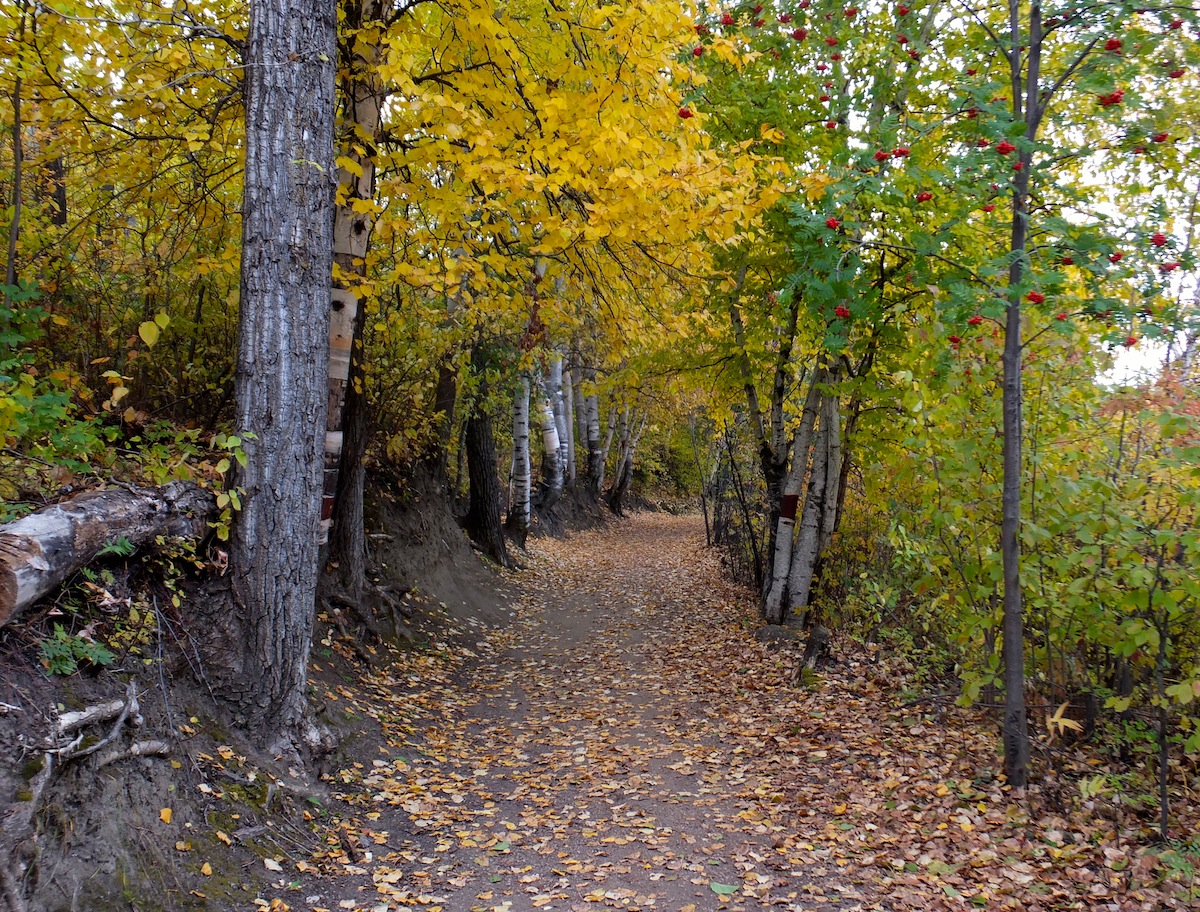
Fall adds leaf litter. Fresh leaves hide roots, rocks, and ice patches. They also get slick when wet. In October, assume every leaf-covered section is hiding something. Shorten your stride and lift your knees a little higher.
Early Frost and Shoulder-Season Ice
October mornings in Edmonton often start below freezing. Shaded ravine sections hold frost until noon. North-facing slopes can hold black ice into November. A section you flew through at 6:00 pm in September can be a hazard at 7:00 am in October.
Practical rules:
- Run the sunnier, open trails (Hawrelak Park loops, Rundle Park) when overnight temperatures drop below 0°C.
- Save the shaded ravines for afternoon runs.
- Carry a light pair of traction spikes once you see frost on more than two mornings in a row.
- Walk the downhills when the surface looks glazed. Nobody earns a medal for sliding.
Daylight and Smoke Considerations
Sunrise in Edmonton drops past 8:00 am by early November. Trail running in low light is harder than road running in low light because you cannot see roots or ice. Carry a headlamp from now on. A decent one runs $40 to $90.
Smoke season has mostly passed by October, but late-summer wildfire smoke can linger. When air quality is poor, the extra breathing demand of trails makes it worse. Read why smoke season affects outdoor fitness in Edmonton for the full picture, and check the Air Quality Health Index before you head out.
Reading Effort Instead of Pace
If there is one skill that makes trail running easier, it is this one. Pace lies on trails. Effort does not.
Use Heart Rate, Breathing, or Perceived Effort
Pick one method and stick with it.
- Heart rate: Aim for zone 2 on most trail runs. That is roughly 60 to 70 percent of your maximum heart rate.
- Talk test: If you can speak a full sentence, you are in a good aerobic range. The Mayo Clinic and other clinical sources recommend this approach for general fitness.
- Perceived exertion: Rate effort from 1 to 10. Most trail runs should sit at 4 to 6.
Watches also misread GPS in the tree cover of the river valley. Distance can drift by 5 percent or more under dense canopy. Do not trust a single number.
Plan Time, Not Distance
A great trick for new trail runners is to run by time. Instead of an 8K loop, run for 50 minutes. You get the same training stimulus without the stress of hitting a pace.
Here is a simple conversion. If your road easy pace is 6:00 per km, expect 6:45 to 7:30 per km on typical river valley singletrack. Expect slower on steep or muddy sections. A 10K road run that takes 60 minutes may take 70 to 80 minutes on trails.
Walk the Hills Without Guilt
Experienced trail runners walk steep climbs. It is strategy, not weakness. Power hiking a hill at an effort of 5 out of 10 often matches the speed of a laboured jog and saves your legs for the flat sections.
A rule that works in the river valley: if your heart rate hits the top of your target zone, walk until it drops. Then jog again. By week four you will be walking less.
Building Trail Fitness Step by Step

You do not need a new training plan. You need a gradual shift. Think of it as adding one trail run to your week and letting your body adapt.
A Four-Week Starter Progression
This plan assumes you already run 5K on roads without trouble.
- Week 1: One easy 30-minute trail run on a gentle path like the Hawrelak Park loop or the Capilano Park trails. Keep the rest of your runs on the road.
- Week 2: One 35-minute run on a trail with some hills, such as the paths around Gold Bar Park.
- Week 3: One 40-minute run. Add one short, steeper climb and practise power hiking it.
- Week 4: Two trail runs this week, one 30 minutes and one 45 minutes. Keep one road run for recovery.
Add the ankle and calf work from earlier. By the end of the month, your stabilizers will start to catch up.
Strength Work That Pays Off
Two sessions per week, 20 minutes each. Keep it simple.
- Single-leg deadlifts, 2 sets of 8 per side
- Step-ups on a bench or stair, 2 sets of 10 per leg
- Lateral band walks, 2 sets of 12 steps each way
- Side planks, 2 holds of 30 seconds per side
Most Edmonton gyms offer a day pass in the $10 to $20 range, and the University of Alberta’s Van Vliet Complex has public access options. If you prefer working out at home, a resistance band costs under $20.
Fold It Into Your Existing Routine
Do not drop your road runs. Trail running is a supplement, not a replacement, until you feel comfortable. For ideas on mixing environments across a week, see how to build an outdoor fitness routine in Edmonton.
Where to Run Trails in Edmonton by Skill Level
Not every trail in the river valley is the same. Start where the footing is kind and graduate when you are ready. The City of Edmonton publishes park and trail information if you want to check closures before you go.
Gentle Trails for First Timers
These have wide, packed surfaces and minimal elevation.
- Hawrelak Park loop: About 2.5 km around the lake. Paved and gravel sections. Parking is free off Groat Road in most seasons, and ETS buses serve the University area nearby.
- Rundle Park: Flat, open, and sunny. Good for frosty mornings. Free parking.
- Louise McKinney Park: Downtown access. Good for easy runs, then connect to the paved river valley trail.
Moderate Trails With Real Terrain
These have roots, short climbs, and mixed surfaces.
- Mill Creek Ravine: Close to Whyte Avenue and Old Strathcona. Stairs, roots, and creek crossings. Street parking is tight on weekends, so take the bus or bike over from the Strathcona side.
- Gold Bar Park: Rolling trails and decent loops on the east side.
- Whitemud Creek Ravine: Longer, more remote, and muddy after rain. Bring layers.
Longer Efforts and Day Trips
Once you are comfortable at 10K on trails, try bigger terrain. Elk Island National Park, east of Sherwood Park, has rolling forest trails and a daily admission fee in the range of $10 to $12 per adult. Check Parks Canada information on canada.ca for current fees. The Cooking Lake-Blackfoot Provincial Recreation Area is another option for longer, quieter loops.
For more places to move outdoors across the seasons, browse the fitness and outdoor movement in Edmonton hub.
Gear, Safety, and Recovery

Trail gear does not need to be fancy. A few well-chosen items make runs safer and less tiring.
Shoes, Layers, and Traction
Trail shoes have deeper lugs for grip, firmer midsoles for rock protection, and often a reinforced toe box. You do not need them for every trail. Packed dirt runs fine in road shoes. But once you hit mud, wet roots, or frost, trail shoes help a lot. Expect to pay $140 to $220 at local running stores like Running Room or Track Shack.
Layering matters more in fall. A thin base layer, a light long-sleeve, and gloves cover most October runs. Add a windproof shell when the temperature is below 5°C. Cotton is a bad idea. It holds sweat and chills you fast.
- Traction spikes: $30 to $60, worth it from late October on
- Headlamp: $40 to $90
- Handheld or vest: $30 to $120 for runs over 90 minutes
- Phone in a zip bag, plus a small whistle
Safety in the River Valley
Tell someone your route. Cell coverage is usually fine in the river valley, but ravine bottoms can lose signal. Watch for coyotes, which are common in Edmonton parks. Keep dogs leashed and give wildlife space. Do not run with both earbuds in. You need to hear cyclists and other trail users.
Know where you are. Edmonton’s river valley trail system has numbered signs at many junctions. Take a photo of the map at the trailhead before you start.
Recovery After Trail Days
Expect soreness in places road running never touched. The outside of the hips and the inner ankle are common. Easy fixes include a 10-minute walk after the run, a protein-rich meal within an hour, and gentle mobility work that evening.
If you want a more structured recovery day, a swim at the Kinsmen Sports Centre, a hot soak at a local spa, or a restorative yoga class on 124 Street or in Old Strathcona all help. Many studios offer drop-in classes for $18 to $25. Stop and see a physiotherapist if pain is sharp, localized, or lasts more than a week. Trail ankles and Achilles issues respond well to early care.
Common Mistakes That Make Trail Running Feel Even Harder
Some of the difficulty is unavoidable. Some of it is self-inflicted. Fix these and the whole experience improves.
Starting Too Fast and Too Far
The classic error. A runner who is comfortable with 10K on roads heads out for 10K on trails and bonks at 6K. Cut your planned distance by 25 to 40 percent on early trail runs. Keep the effort easy. Finish feeling like you could have done more.
Looking at Your Feet
Staring down is natural and it makes things worse. It slows your reaction time and tightens your posture. Look three to five metres ahead. Your peripheral vision tracks the ground right in front of you. Your feet will figure it out. This takes a few weeks to learn, and it is the single biggest technique shift.
Ignoring Fuel and Fluids
Trail runs take longer than their distance suggests. A 10K may take 80 minutes. Bring water for anything past 60 minutes and a small snack, such as a banana or a gel, for anything past 90. In October, runners often underestimate fluid needs because it is cold. You still sweat.
A quick checklist before heading out:
- Check the weather and the AQHI
- Confirm sunrise and sunset times
- Pick a route that matches your current fitness
- Pack water, a layer, and your phone
- Tell someone where you are going
If you prefer group movement during the warmer months, outdoor fitness classes in Edmonton in the summer are a good way to build leg strength before trail season.
Related Articles
- Best Running Trails Edmonton River Valley: Where Locals Actually Run
- How to Train for a Half Marathon in Edmonton: A 16-Week Local Runner’s Guide
Sources & References
Find Trusted Wellness Spots in Edmonton
Browse our independent guide to Edmonton’s spas, fitness studios, and wellness services. Local. Honest. Free.
Frequently Asked Questions
Is trail running really harder than road running, or does it just feel that way?
It is harder in measurable ways. Heart rate runs higher at a given pace, and uneven terrain recruits more muscle. Most runners are 10 to 20 percent slower for the same effort, though it varies by trail. Judge your effort by breathing and heart rate, not speed.
How much slower should I expect to run on Edmonton trails?
Plan for 45 to 90 seconds slower per kilometre on typical river valley singletrack. Muddy or leaf-covered trails in October can add more. Time-based runs, such as 45 minutes instead of 8K, remove the pressure.
Do I need trail shoes to start?
Not on dry, packed paths like the Hawrelak Park loop or Rundle Park. Once you move onto Mill Creek or Whitemud Creek in wet or frosty conditions, trail shoes with real lugs give much better grip. Budget $140 to $220.
Why do my legs and ankles feel so sore after a trail run?
Trail running loads stabilizer muscles and creates more eccentric work on descents. Both cause soreness that road running does not. Add calf raises and single-leg balance work, and limit trail runs to one or two per week for the first month.
Can I keep trail running in Edmonton once winter hits?
Yes, with traction spikes and layers. Packed snow on trails in the river valley is often easier on the legs than summer mud. Choose open, sunny routes in the afternoon, carry a headlamp, and walk any icy downhill sections.