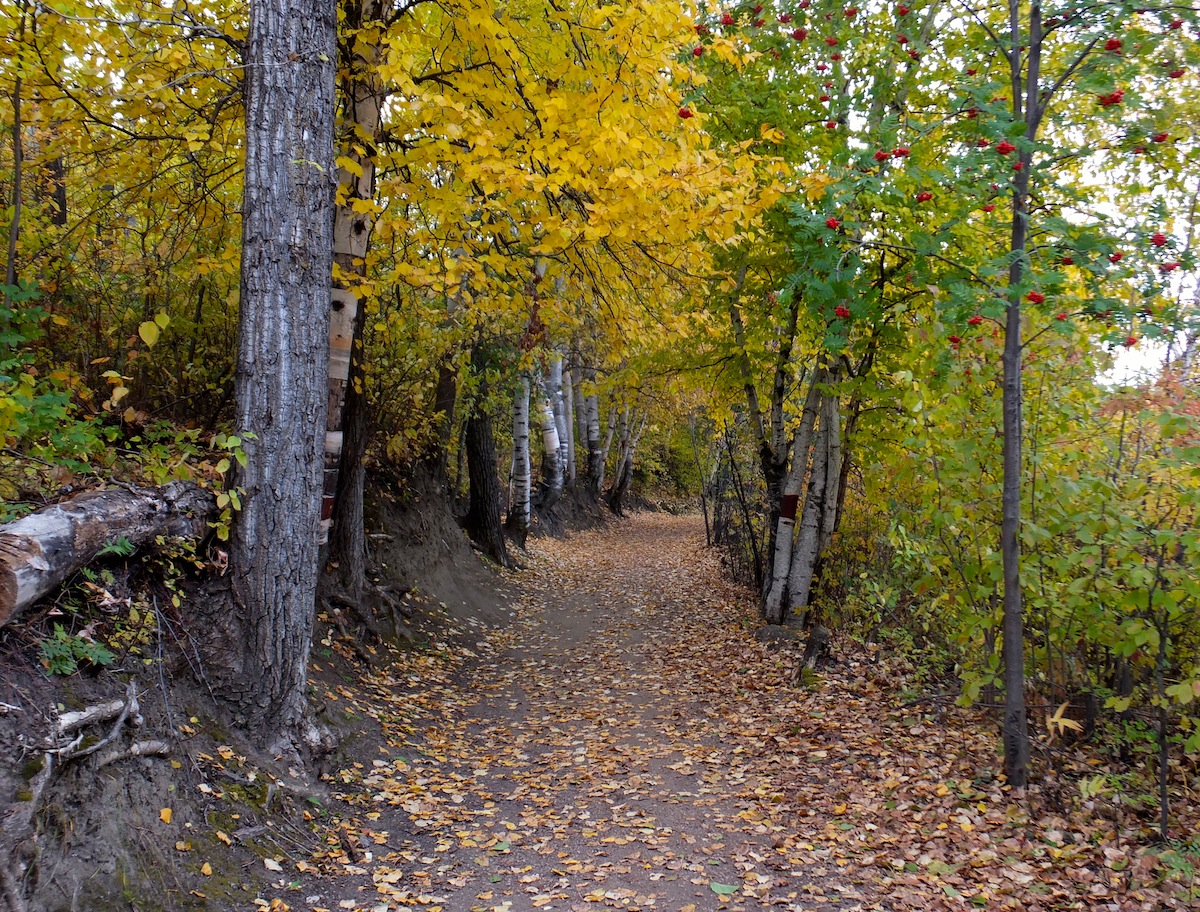
Outdoor strength training without equipment means building muscle using your body weight, gravity, and what the park already has: a bench, a hill, a set of stairs, a tree branch. By the end of this guide, you will know the six movement patterns that cover your whole body, how to progress each one, where to train in Edmonton, how to dress for cold, and what to do when the air quality says stay inside. It is October, which makes this the best month of the year to start. The mosquitoes are gone, the heat is gone, and the river valley is at its best. Snow is coming, so the habit you build now needs to survive it.
Last reviewed:
What Bodyweight Strength Training Actually Is

Bodyweight training is resistance training where your own mass is the load. It works because muscle responds to tension, not to the brand of the tool creating it. A push-up loads your chest, shoulders, and triceps with roughly 60 to 65 percent of your body weight. A slow, deep split squat can feel heavier than a barbell squat if you take it to your limit.
Why it counts as real strength work
Health agencies treat it as the real thing. The CDC’s adult physical activity guidelines recommend muscle-strengthening activity on at least 2 days a week, covering all major muscle groups. The Mayo Clinic’s strength training overview lists body weight exercises alongside free weights and machines as valid options. Nobody at the clinic is asking you to buy a rack.
The mechanism is simple. Muscles grow when they work close to fatigue. That can happen at 5 repetitions with a heavy load or at 20 repetitions with a lighter one. With body weight, you control difficulty by changing leverage, tempo, and range of motion instead of adding plates.
What it does not do
Be honest about the limits. Bodyweight work builds strength, muscle, and joint resilience very well. It is less efficient for maximal strength in the legs, because your legs are already used to carrying you around all day. The fix is unilateral work (one leg at a time), slower tempos, and pauses. Those make a 75 kg body feel like a lot more.
Why train outside in Edmonton
Edmonton has an unusual asset. The North Saskatchewan River Valley is one of the largest stretches of urban parkland in North America, and the City of Edmonton maintains hundreds of kilometres of trails through it. Add 17 hours of daylight in June and a reliable dry autumn, and the outdoor season is better than people give it credit for. The trade-off is winter. Long stretches below -20°C change what you can do, and later sections cover how to handle that.
For the bigger picture on training outdoors here across all seasons, the Edmonton Wellness Guide fitness and outdoor movement section is the place to start.
The Six Movement Patterns That Cover Your Whole Body
Skip the random exercise lists. Strength training works best when it hits six basic patterns. Cover each one twice a week and you have covered everything.
Squat and hinge: the lower body
The squat pattern bends the knees and loads the quads. The hinge pattern bends at the hips and loads the glutes and hamstrings. Most people over-train squats and ignore hinges, which is a common reason for sore knees and tight lower backs.
- Squat options: air squat, tempo squat (3 seconds down), bench box squat, split squat, Bulgarian split squat with your back foot on a bench.
- Hinge options: good morning (hands behind head), single-leg Romanian deadlift (reach toward the ground with a flat back), glute bridge, single-leg hip thrust with your shoulders on a bench.
A park bench at 45 cm height is the single most useful piece of outdoor gear in the city. It gives you step-ups, Bulgarian split squats, hip thrusts, incline push-ups, and dips.
Push and pull: the upper body
The push pattern covers push-ups and their variations. Pushing is easy to find outdoors. Pulling is the hard one, because pulling needs something to hang from. Without a bar, your options narrow, so plan for it.
- Push progressions, easiest to hardest: wall push-up, incline push-up on a bench, knee push-up, full push-up, feet-improved push-up, archer push-up, pseudo-planche push-up.
- Pull options: bar hangs and pull-ups on a playground frame, inverted rows under a sturdy low bar or railing, towel rows around a post, backpack rows loaded with water bottles.
Test any bar or railing before trusting it. Bounce your weight on it gently first. Playground frames at most Edmonton parks are rated for kids, so check that the structure does not flex under adult weight.
Core: the anti-movement work
The core resists motion more than it creates it. Planks, side planks, dead bugs, and bird dogs teach your trunk to stay rigid while your limbs move. These are more useful than endless crunches. Hold a plank for 30 to 45 seconds with good form, and stop when your hips sag. Quality beats duration.
Where to Train in Edmonton: Parks, Stairs, and Hills

The best outdoor gym in the city is not a gym. It is the combination of terrain you already live near. Here is how to read your local park like a workout plan.
River Valley stairs and hills
Stairs are your resistance equipment. Edmonton’s river valley has staircases connecting the top of the bank to the trails below, including routes near Louise McKinney Park downtown, the Mill Creek Ravine, and Cloverdale. Stair repeats build the glutes, calves, and cardiovascular fitness at once. Check the current status of any staircase on the City of Edmonton website before you go, because trail and stair closures happen for maintenance and slope repairs.
- Beginner: 5 climbs at a steady walk, walking down for recovery.
- Intermediate: 8 climbs at a brisk pace, taking every second step on 2 of them.
- Advanced: 10 climbs, with a set of 10 jump squats at the top of every third one.
Walk down. Descending stairs is hard on the knees and is where most stair-training injuries happen.
Parks with useful features
Pick parks by what they offer, not how pretty they are. A flat field is fine for lunges and burpees. A bench gives you incline work. A playground gives you a pull-up bar.
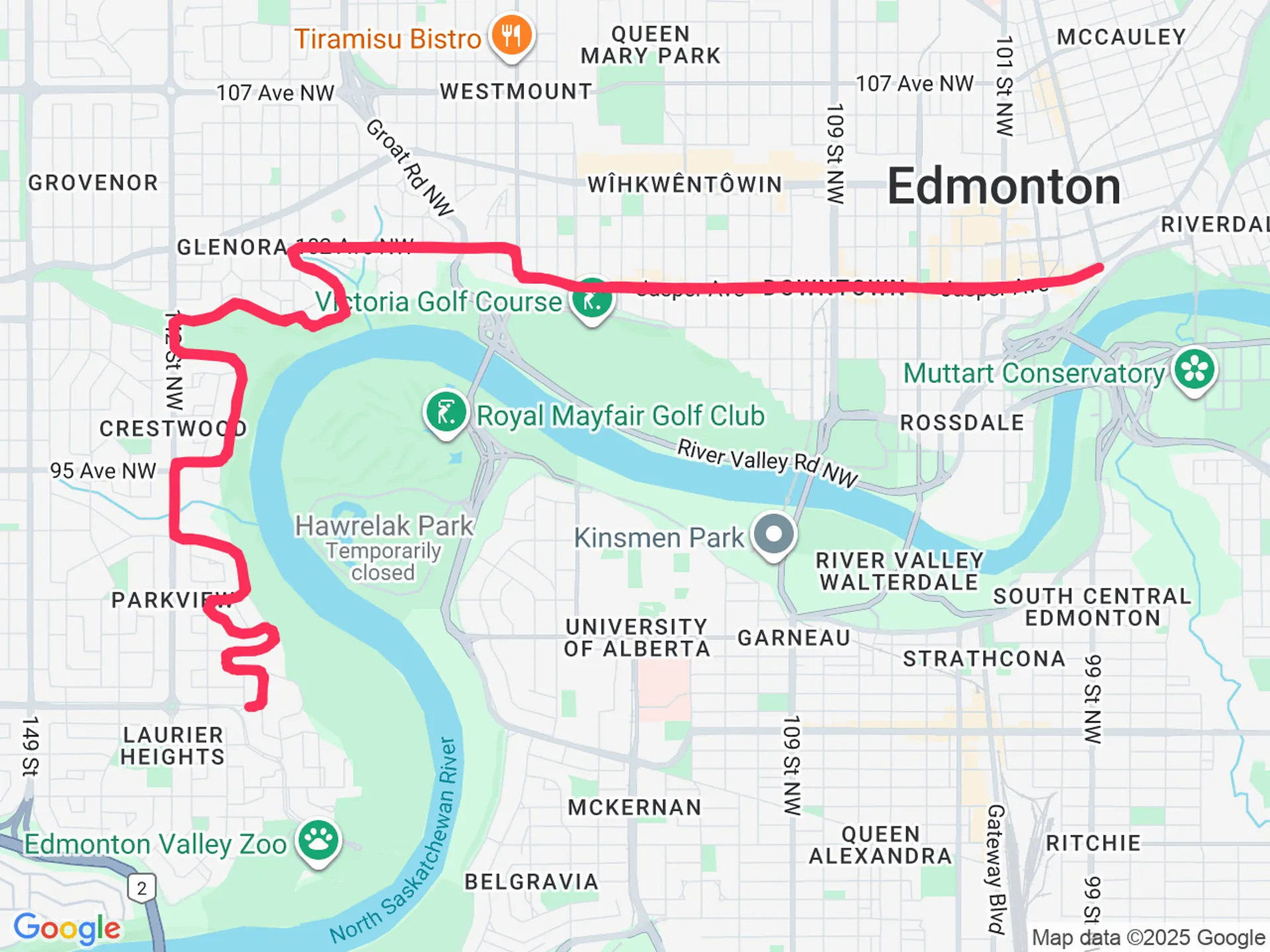
- Hawrelak Park (Groat Road area): large flat lawns, picnic tables, and benches around the lake. Busy on weekends with festival setup, so go early. Parking lots fill quickly in summer.
- Victoria Park and the downtown river valley: hills, stairs, and open space. Good transit access, since the LRT and bus routes serve the downtown core.
- Kinsmen Park and the Buena Vista area: wide grass, bench seating, and a playground for hangs and rows.
- Rundle Park (east end): flat paths and large open grass. Easy parking and fewer crowds.
- Borden Park (Highlands): trees, benches, and a playground. Quiet on weekday mornings.
- Your neighbourhood school field: often the best option. Flat, empty after school hours, and a short walk from home.
Several parks also have fixed outdoor fitness stations. The City of Edmonton lists park amenities on its website, and a separate guide on free outdoor workout equipment in Edmonton parks will be useful if you want the full map.
Using the neighbourhood itself
Not everyone lives beside the river. In Old Strathcona, a stairwell, a low wall, and a patch of grass are enough. In Windermere or Sherwood Park, a cul-de-sac and a park bench do the job. The principle holds anywhere. You need a flat surface, something at knee height, something to push against, and something to hang from if you can find it.
The Workout: A Step-by-Step Beginner Circuit
This is the core of the guide. Start here, even if you have trained before. Following the steps in order gives your joints and tendons a week or two to adjust to outdoor surfaces and cooler air.
Step 1: Warm up for 6 to 8 minutes
Cold muscles and cold air do not mix. In October, mornings sit around 0°C to 8°C, so spend extra time warming up. Do this sequence:
- 2 minutes of brisk walking or marching in place.
- 10 arm circles each direction.
- 10 leg swings per leg, front to back, holding a tree or bench.
- 10 air squats at half depth.
- 10 hip circles each direction.
- 8 slow cat-cows on the ground, or 8 standing torso rotations if the grass is wet.
You should feel warm in the core and slightly flushed before you start the main set. If you are still cold, add another 2 minutes.
Step 2: The main circuit
Do each exercise for the listed reps, rest 45 to 60 seconds, then move on. Complete 3 rounds. The whole thing takes about 30 to 35 minutes.
- Bench step-ups: 10 per leg. Drive through the heel of the top foot. Do not push off the bottom foot.
- Incline push-ups: 8 to 12 reps with hands on the bench. Lower the bench height as you get stronger.
- Glute bridges: 15 reps with a 2-second squeeze at the top.
- Inverted rows or backpack rows: 8 to 10 reps. Pull your shoulder blades back and down.
- Split squats: 8 per leg. Keep your torso upright and lower slowly for 3 seconds.
- Forearm plank: 30 seconds. Squeeze your glutes and keep ribs down.
Stop each set 2 reps before failure at first. The goal in week one is to learn the movements, not to be wrecked the next day.
Step 3: Cool down and record
Walk for 3 minutes. Stretch your hip flexors, hamstrings, and chest for 30 seconds each. Then write down what you did. A note on your phone is enough: date, exercises, reps, and how hard it felt from 1 to 10. After four weeks, this record tells you exactly when to make it harder.
How to Progress Without Adding Weight

Progression is what separates exercise from training. If you do the same 10 push-ups for three months, you will stay at 10 push-ups. Without plates, you need other levers.
Five ways to make a movement harder
- Change leverage. Move from incline push-ups to flat push-ups to feet-improved push-ups. Lower the bench by a step.
- Slow the tempo. Take 4 seconds to lower and 1 second to rise. A slow squat of 10 reps feels like a different exercise.
- Pause. Hold the bottom position for 2 seconds. This removes momentum.
- Go unilateral. Replace squats with split squats, then single-leg box squats. Replace bridges with single-leg bridges.
- Add load from your pack. A backpack with 5 to 10 kg of water bottles or books adds load to squats, lunges, and rows. A 10 litre jug is an easy, cheap option.
A simple progression rule
Use the double progression method. Pick a rep range, such as 8 to 12. Work in that range until you hit 12 reps on every set with good form. Then make the movement harder and drop back to 8. Repeat. It is easy to track and works at any level.
Quick-reference progression table
| Pattern | Beginner | Intermediate | Advanced |
|---|---|---|---|
| Squat | Bench box squat | Split squat | Bulgarian split squat, 3-second lower |
| Hinge | Glute bridge | Single-leg bridge | Single-leg RDL with loaded pack |
| Push | Incline push-up | Full push-up | Feet-improved or archer push-up |
| Pull | Backpack row | Inverted row | Pull-up or slow negative pull-up |
| Core | Dead bug | Forearm plank | Plank with shoulder taps or body saw |
| Conditioning | Stair walk | Stair run | Stair run with jump squats |
Building a Weekly Plan That Fits Edmonton’s Seasons
A plan only works if you can follow it in January. Build the routine now with a winter fallback in mind. A broader walk-through of structuring a year-round outdoor schedule is covered in the guide on building an outdoor fitness routine in Edmonton.
The three-day weekly template
Three sessions a week is enough for most people. Space them out so you get a rest day between each.
- Monday: full-body circuit (the beginner circuit above).
- Wednesday: lower-body focus plus stairs. Split squats, bridges, step-ups, and 6 to 8 stair climbs.
- Friday: upper-body and core focus. Push-ups, rows, planks, dead bugs, and a short walk.
- Weekend: a long walk or easy trail run in the river valley. Unstructured movement counts.
This hits the CDC target of two strength days and then some. The weekend walk handles the aerobic side.
Fall and early winter adjustments
October through December is a split season. Early October is dry and mild. By November, you will see ice and snow on trails. Wet leaves on stairs are slippery, so slow down on descents. Move your sessions to midday when it is warmest, and shorten rests so you do not cool off.
- Wear shoes with real grip. Trail runners with a good tread beat flat gym shoes.
- Skip floor exercises on frozen or wet ground. Use a bench, a rail, or stay standing.
- Cut your session to 20 minutes if the temperature drops below -10°C and focus on standing movements.
Dressing for cold
Use three layers. A thin moisture-wicking base, a mid-layer fleece, and a wind-blocking shell. Cotton holds sweat and chills you fast, so avoid it. Wear a toque and thin gloves. Start slightly cold. If you are comfortable standing still, you will overheat in 10 minutes.
Hands are the weak point for outdoor push-ups and rows on cold metal. Thin liner gloves help. On days below -15°C, most people do better moving the strength session inside and keeping the outdoor time for walking.
Air Quality, Weather, and When to Move Indoors

An outdoor routine needs rules for the days when outdoors is a bad idea. Make those rules ahead of time so you are not negotiating with yourself at 6:30 a.m.
Smoke season and the air quality index
Wildfire smoke affects Alberta most summers. Fine particles from smoke can irritate the lungs, and heavy breathing during a workout pulls more of them in. Check the Air Quality Health Index before you go. The federal government explains how to read the scale on its Air Quality Health Index page. A reading of 1 to 3 is low risk. At 4 to 6, people who are sensitive should cut back on hard exertion outdoors. At 7 and above, move indoors. A fuller explanation of how smoke season affects outdoor fitness in Edmonton is worth reading before next summer.
Bodyweight training handles smoke days well because it needs so little. A living room, a hallway, and a backpack replace the park. Use the same circuit and the same progression rules.
Heat, cold, and ice
Know your limits. Cancel or move indoors in these situations:
- Air quality health index at 7 or higher.
- Wind chill below about -25°C, when exposed skin can freeze in minutes.
- Heavy ice on stairs or trails with no traction.
- Thunderstorms, which are common on summer afternoons.
- Heat above 30°C. Train before 9 a.m. or after 7 p.m. in July.
Alberta Health Services shares seasonal health guidance on its public website, including cold and heat safety information.
Your indoor backup plan
Keep a 20-minute indoor version ready. It might be: 3 rounds of air squats, incline push-ups against a kitchen counter, glute bridges on the floor, backpack rows, and a plank. The Kinsmen Sports Centre, the Clareview and Terwillegar Recreation Centres, and the University of Alberta’s Van Vliet Complex all offer drop-in access, and daily rates generally run in the $8 to $15 range. Check current rates before you go. For group options, a look at outdoor fitness classes in Edmonton during summer shows what is available once the weather turns.
Common Mistakes and Safety Rules
Most injuries in bodyweight training come from doing too much too soon, or from poor setup. These are the ones to watch.
Mistakes beginners make
- Skipping the warm-up. Cold air makes this worse. Give it the full 6 to 8 minutes.
- Doing only push exercises. Push-ups are easy to find outdoors, so people overdo them and neglect rows and hinges. That creates rounded shoulders.
- Training to failure every session. Leave 1 to 2 reps in reserve. Soreness for two days means you overdid it.
- Trusting any bar or rail. Always test it first.
- Ignoring tendon pain. Muscle soreness fades in 48 hours. Sharp or joint pain that lingers is a reason to stop and back off.
When to get help
If you have a heart condition, high blood pressure, joint problems, or have been inactive for a long time, talk to your doctor or a physiotherapist before starting. Many Edmonton physiotherapy clinics offer an assessment for around $100 to $150, and extended health plans often cover part of it. A single session to check your squat and push-up form is a reasonable investment if you are unsure.
Etiquette in shared spaces
You are sharing the park. Keep off the pathway when you stretch or do floor work. Do not hog the one good bench at lunch hour. Pack out anything you bring, and avoid playground equipment when kids are using it. Park fitness works best when everyone shares it.
Related Articles
- Best Running Trails Edmonton River Valley: Where Locals Actually Run
- How to Train for a Half Marathon in Edmonton: A 16-Week Local Runner’s Guide
Sources & References
Find Trusted Wellness Spots in Edmonton
Browse our independent guide to Edmonton’s spas, fitness studios, and wellness services. Local. Honest. Free.
Frequently Asked Questions
Can you really build muscle with no equipment?
Yes. Muscle grows when you train close to fatigue, and body weight can do that if you slow the tempo, use one limb at a time, and raise the difficulty over time. Start with the beginner circuit and track your reps for four weeks. Most beginners see clear strength gains within that time.
How often should I do outdoor bodyweight workouts?
Two to three sessions a week is a good target. The CDC recommends muscle-strengthening activity on at least two days a week for adults. Leave a rest day between sessions that hit the same muscles.
Where can I find a pull-up bar in Edmonton?
Most neighbourhood playgrounds have a frame or monkey bars that work for hangs, rows, and pull-ups. Hawrelak Park, Borden Park, and Kinsmen Park all have playground areas worth checking. Test the structure with your weight before you commit, and avoid using it when children are around.
Can I train outside in an Edmonton winter?
You can, with limits. Dress in three layers, keep sessions to 20 to 30 minutes, and stick to standing movements like step-ups, lunges, and push-ups against a bench or wall. When the wind chill drops below about -25°C, move indoors.
What do I do on smoke days?
Check the Air Quality Health Index before you leave. If it reads 7 or higher, train indoors with the same circuit at home or drop in to a rec centre like Terwillegar or Clareview. If it reads 4 to 6, shorten the session and keep the effort moderate.