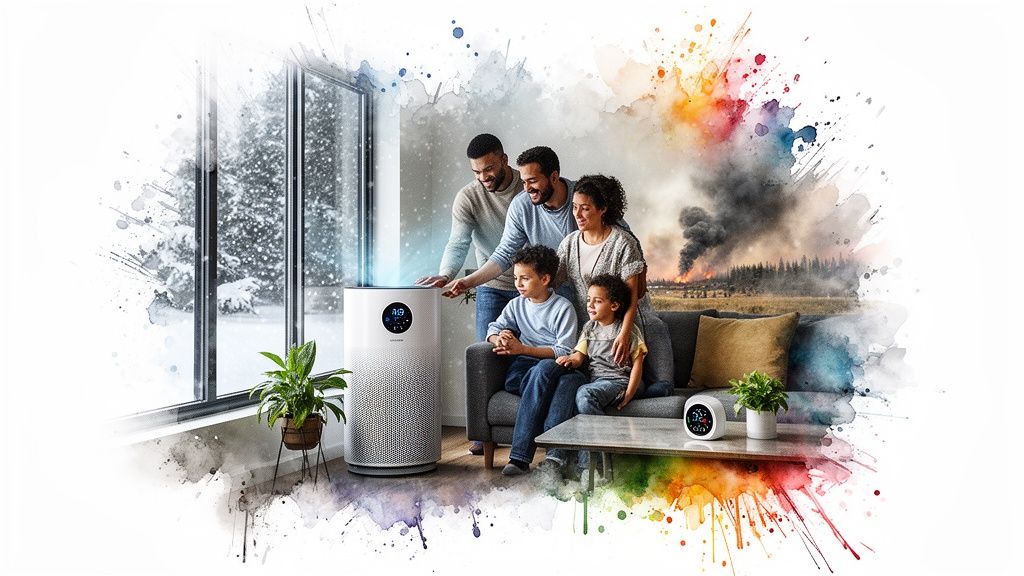
Improving the air inside your home here in Edmonton is a tale of two seasons. It's about fighting the thick, hazy smoke of a July wildfire one month, and then battling the stale, dry air of a sealed-up house in the dead of a -30°C January. A smart plan means having a solid strategy for smoke, a way to get fresh air when it’s freezing, and a handle on humidity all year long.
For more on this, see our smoke season affect guide.
Why Our Air Is a Unique Edmonton Challenge
Let's be honest: living in Edmonton means dealing with air quality issues that are uniquely ours. We can't just follow generic advice meant for a milder climate. Our homes are our shelters, whether we're hiding from a smoky summer afternoon or a bone-chilling winter night, and the quality of the air we breathe inside really matters.
For more on this, see our summer winter running guide.
The most obvious battle is against our increasingly intense wildfire smoke season. It's the reason Folk Fest can feel like a campfire and the river valley disappears into an acrid haze. That smoke doesn't just stay outside; it worms its way into our homes, turning our living rooms into traps for harmful microscopic particles.
The Summer Smoke Siege
During a bad smoke event, the air outside can become genuinely hazardous. This isn't just an inconvenience; it's a measurable health threat. In recent years, data shows July was often our most polluted month, with an average Air Quality Index (AQI) of 83, driven almost entirely by wildfire smoke. Local monitoring stations have shown PM2.5 levels climbing well into the "unhealthy" ranges, proving that what’s outside quickly becomes an indoor problem.
We spend around 90% of our lives indoors. When the air outside is compromised by smoke or extreme cold, the quality of our indoor environment becomes one of the most significant factors affecting our day-to-day health. It's not just wellness fluff; it's practical self-preservation.
The Winter Lockdown Effect
Then, we have the complete opposite problem: our long, intensely dry winters. When the temperature plunges to a classic Edmonton -30°C, we seal our homes up tighter than a drum. For months on end, we're just recirculating the same air, which gets progressively stale and loaded with indoor pollutants. It’s a latitude thing, and it can contribute to that feeling of seasonal affective disorder (SAD) we all know too well.
For more on this, see our prevent seasonal wellness guide.
Think about everything that gets trapped inside with us:
- Cooking Fumes: Gas stoves, in particular, release nitrogen dioxide and other compounds with nowhere to go.
- Cleaning Products: Volatile organic compounds (VOCs) from sprays and scented products just hang in the air.
- Just Living: Dust, pet dander, and the carbon dioxide we exhale all build up when there's zero fresh air exchange.
This sealed-in environment, combined with the extreme prairie dryness, creates its own set of issues, from irritated sinuses and dry skin to that winter brain fog.
Our unique northern climate, with its dramatic swings from smoky summers to sealed-off winters, demands a specific game plan. Understanding these local realities is the first step toward effective indoor air quality improvement. This isn't a trend; for us, it's a practical survival guide. If you want to dive deeper, our guide on Edmonton's distinct climate provides more context. This is all about adapting our homes to the rhythm of life in our city.
For more on this, see our summer winter running guide.
How to Assess What You're Actually Breathing
Before you can fix your home's air, you need to know what you're up against. Think of it as a fact-finding mission right in your own living room—no science degree required. The goal isn't to become an expert, but to gather real data so you can make smart, targeted changes instead of just guessing.
Getting a baseline gives you a starting point. It helps you identify the main culprits so you can focus your efforts for the biggest impact.
The Key Players in Your Home's Air
In Edmonton, we’re mostly dealing with three major issues inside our homes. Each one tends to spike at different times of the year and needs a slightly different approach to manage.
- Particulate Matter (PM2.5): These are microscopic particles that come from dust, cooking, and, most importantly for us, wildfire smoke. They're tiny enough to get deep into your lungs, making them a top health concern.
- Volatile Organic Compounds (VOCs): These are gases released from everyday items—think new furniture, fresh paint, cleaning products, and even those plug-in air fresheners. They can cause headaches and irritation, especially when a home is sealed up tight for a classic Strathcona winter.
- Humidity Levels: Our climate is famously dry. When indoor humidity dips below 30%, it can lead to dry skin, irritated sinuses, and even make you more susceptible to colds. On the flip side, if it gets too high (above 50%), it can encourage mould growth.
This infographic breaks down our two biggest seasonal air quality challenges—the smoke of summer and the stale, trapped air of winter.
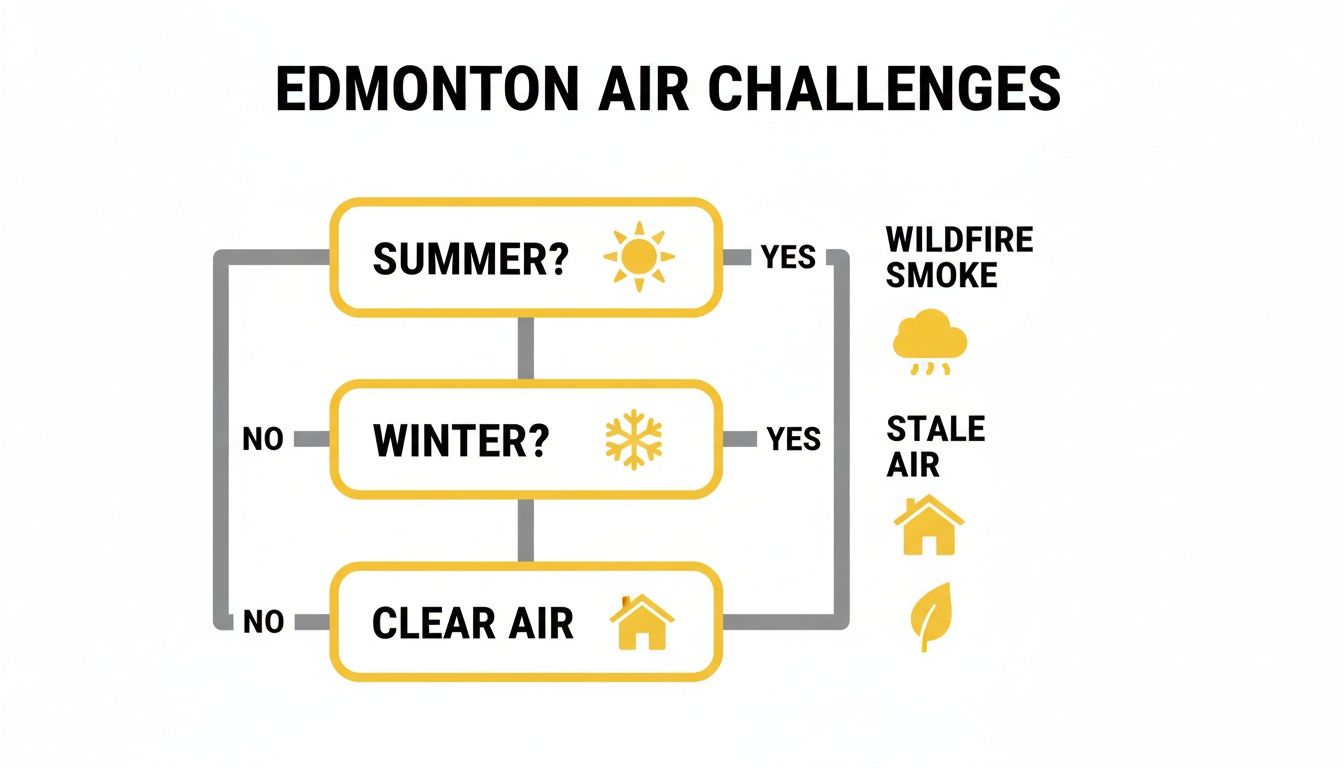
Whether it's one of those 17-hour summer days or a -30°C winter night, our homes face distinct pressures that demand different strategies.
Using an Air Quality Monitor
The single best tool you can get for this job is an affordable home air quality monitor. These devices give you real-time numbers for PM2.5, VOCs, and often humidity and CO2 as well. It's incredibly revealing to see the numbers spike when you start cooking or drop after you open a window for five minutes.
So, what do the numbers actually mean? During a heavy smoke day, when the sky over the river valley is orange, the outdoor PM2.5 reading might be over 150. Inside, a "good" reading in that scenario would be under 15, which shows your filtration is working. On a clear winter day, your PM2.5 should be very low (under 5), but you might see your CO2 levels creeping up, telling you it's time to get some fresh air circulating.
An air quality monitor transforms an invisible problem into visible, actionable data. It's the difference between wondering if your air is bad and knowing exactly what's wrong and when.
These pollutants are not something to take lightly. To get a clearer picture of the risks, especially during our increasingly hazy summers, you can learn more about the health effects of wildfire smoke in our detailed guide.
Your Room-by-Room Source Audit
While a monitor provides the hard data, you can learn a lot just by walking through your home with a critical eye. Grab a notepad and do a quick audit of each room, looking for these common offenders.
Living Areas:
- Scented products: Do you use scented candles, plug-in air fresheners, or diffusers? These are major sources of VOCs.
- New furniture: That "new couch smell" is actually chemicals off-gassing. This can last for weeks or months.
- Old textiles: How old are the rugs and carpets? They can trap years of dust and allergens.
Kitchen:
- Exhaust fan: Do you use it every time you cook, especially on a gas stove? Unvented cooking is a huge source of indoor PM2.5 and nitrogen dioxide.
- Cleaning supplies: Make sure your cleaning products are well-sealed to prevent VOCs from leaking out.
Basement & Bedrooms:
- Musty smells: Any hint of a musty odour, especially in older homes in neighbourhoods like Glenora or Highlands, can be a sign of hidden mould or mildew from moisture issues.
- Humidifier hygiene: If you use a humidifier, when was the last time you cleaned it? A dirty one can spread bacteria into the air you breathe.
Combining this hands-on assessment with the data from a monitor gives you a powerful starting point. It helps you prioritize what to fix first, ensuring your efforts directly address the real challenges inside your Edmonton home.
Mastering Filtration and Ventilation in Your Home
Alright, let's get into the heavy hitters of indoor air quality. Once you have a sense of what's in your air, the next move is to actively kick out the bad stuff and invite in the good. This is where filtration and ventilation become your best friends, especially when you’re up against our two biggest Edmonton challenges: wildfire smoke and stale winter air.
The goal here is simple: create a clean-air sanctuary inside your home, whether the sky is orange or it’s a frosty -30°C outside.
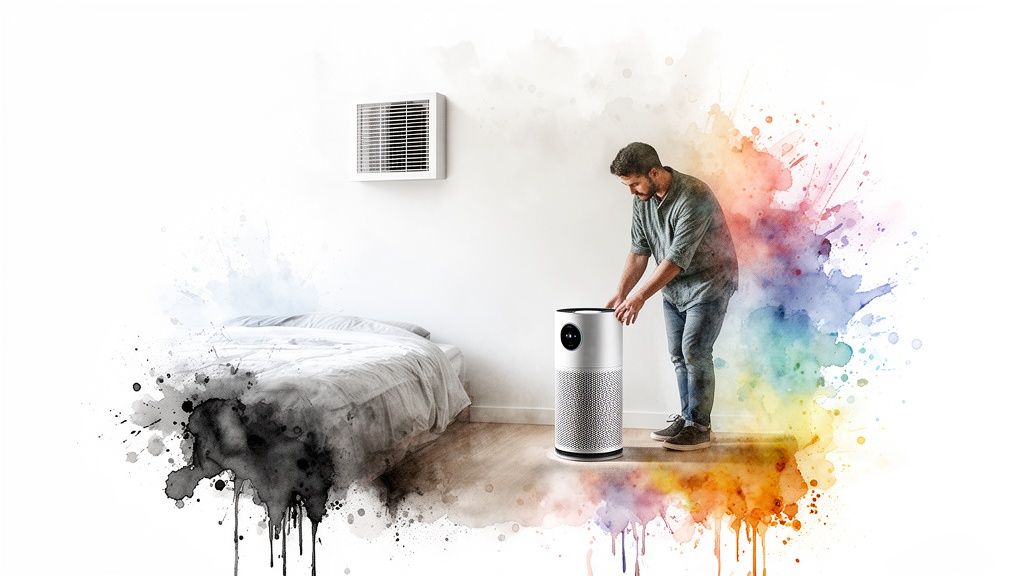
Why HEPA Filters Are Non-Negotiable Here
You’ve probably heard the term HEPA (High-Efficiency Particulate Air) thrown around, but it’s critical to understand why these filters are so vital for us. They aren’t just fancy furnace filters; they are medical-grade tools designed to trap incredibly tiny particles.
A true HEPA filter is certified to capture 99.97% of airborne particles that are 0.3 microns in size. Wildfire smoke particles, the ones posing the biggest health risk, fall squarely into this size range. That makes HEPA filtration our single most effective weapon during smoke season.
We're not just talking about dust bunnies. We're talking about capturing the microscopic troublemakers that can lodge deep in our lungs.
When you invest in a HEPA filter, you're not just buying an appliance; you're buying a frontline defence system against the very specific threat of wildfire smoke that defines our Edmonton summers.
Choosing the right device is key. A small purifier is perfect for a bedroom in a Windermere condo, while a larger unit might be needed for the main floor of a house in Strathcona. For more specific guidance on picking and using these devices, we have a whole collection of HEPA filter tips for Edmonton homes.
Choosing Your Air Filtration Strategy
There are a few ways to bring HEPA-level filtration into your home, each with its own costs and benefits. Let's be honest, some are expensive, but there are practical options for every budget.
| Filtration Method | Best For | Typical Cost (CAD) | Pros | Cons |
|---|---|---|---|---|
| Portable Air Purifiers | Creating a clean-air zone in a specific room (e.g., bedroom). | $150 – $800+ | Highly effective (true HEPA), flexible placement, easy to use. | Only cleans one room at a time, ongoing filter replacement costs. |
| High-MERV Furnace Filter | Good baseline filtration for the whole house. | $30 – $60 (per filter) | Affordable, treats all circulated air, no extra appliance. | Less effective than HEPA, can strain older furnace fans. |
| DIY Box Filter (Corsi-Rosenthal) | High-performance, low-cost filtration for a large space. | Under $100 | Extremely cost-effective, rivals performance of expensive units. | Bulky, not pretty, can be noisy. |
Ultimately, the best strategy often involves a combination. A MERV 13 furnace filter provides a great baseline for your whole home, while a portable HEPA purifier ensures your bedroom is a sanctuary for sleep during the worst smoke days.
Ventilation When It’s Freezing Outside
Ventilating feels completely wrong during an Edmonton winter. The last thing any of us want is to open a window when it's cold enough to freeze your eyelashes, letting all that precious heat escape. But without fresh air, indoor pollutants and CO2 build up, leading to that stuffy, drowsy feeling we all know too well.
This is where your HRV (Heat Recovery Ventilator) becomes a true game-changer. Many newer Edmonton homes are built with an HRV, and if you have one, you need to be using it.
An HRV is a clever system that brings fresh air in from outside while exhausting stale air from inside. The magic is in the "heat recovery" part: the outgoing stale air passes over a heat exchanger, warming up the incoming fresh air. This means you get fresh oxygen without a massive hit to your heating bill.
To make the most of it, run your HRV intermittently during the coldest months. An hour in the morning and an hour in the evening can make a huge difference in clearing out accumulated CO2 and VOCs. Just remember to clean the HRV filters a couple of times a year—it’s a simple task that keeps it running efficiently.
Finally, don’t forget the low-tech solutions. Using your bathroom fan during and after a shower, and your kitchen range hood every single time you cook, are powerful habits. These fans are designed for "spot ventilation," pulling pollutants and moisture out of your home right at the source before they can spread. It’s a small action with a big impact on your overall indoor air quality improvement.
Controlling Pollutant Sources and Managing Humidity
While a high-end filter is a great line of defence, a truly effective approach to indoor air quality improvement starts by cutting off pollution at the source. Think of it as preventative medicine for your home's air. It's about making small, intentional choices that stop pollutants from getting into your air in the first place—and it’s almost always cheaper than trying to scrub them out later.
Tied directly to this is the delicate art of managing humidity, something we Edmontonians know a thing or two about. Our climate swings from bone-dry cold to brief, humid summer spells. Keeping your indoor environment balanced is crucial for both comfort and health.
Taming Indoor Pollutant Sources
So many everyday activities and items release compounds that tank our air quality. The good news? We have a surprising amount of control over these sources, and making smarter choices doesn't have to be complicated or expensive.
The kitchen is a major hotspot. Cooking, especially on a gas stove, releases a cocktail of particulate matter and nitrogen dioxide. The simplest, most non-negotiable habit you can build is to use your range hood fan every single time you cook. Yes, even if you're just boiling water. This one action vents pollutants directly outside before they get a chance to circulate through your entire home.
Beyond the kitchen, it's about being mindful of what you bring inside:
- Choose Low-VOC Everything: When you’re tackling that weekend painting project, always look for paints labelled "low-VOC" or "zero-VOC." Volatile organic compounds are chemicals that "off-gas" for weeks, creating that lingering “new paint smell” and polluting your air long after the job is done.
- Rethink Your Cleaning Supplies: Harsh chemical cleaners and artificially scented products—like plug-in air fresheners or strong sprays—are huge VOC contributors. Swapping them for simple solutions like vinegar and water or choosing unscented, eco-friendly products makes a massive difference.
- Let New Items Breathe: That “new car smell” from a couch, rug, or mattress is also VOCs. If possible, let new furniture air out in a well-ventilated space (like a garage or a spare room with an open window) for a few days before bringing it into your main living area.
Small, consistent habits are the bedrock of good source control. Always using the range hood, choosing unscented cleaners—these things prevent problems from starting, reducing the burden on your air purifiers and, more importantly, your lungs.
The Great Edmonton Humidity Balancing Act
In Edmonton, managing indoor humidity is a year-round challenge. Our winters are notoriously dry, capable of dropping indoor humidity levels below 20%. That kind of air leads to dry skin, irritated sinuses, and a higher susceptibility to catching whatever cold is going around.
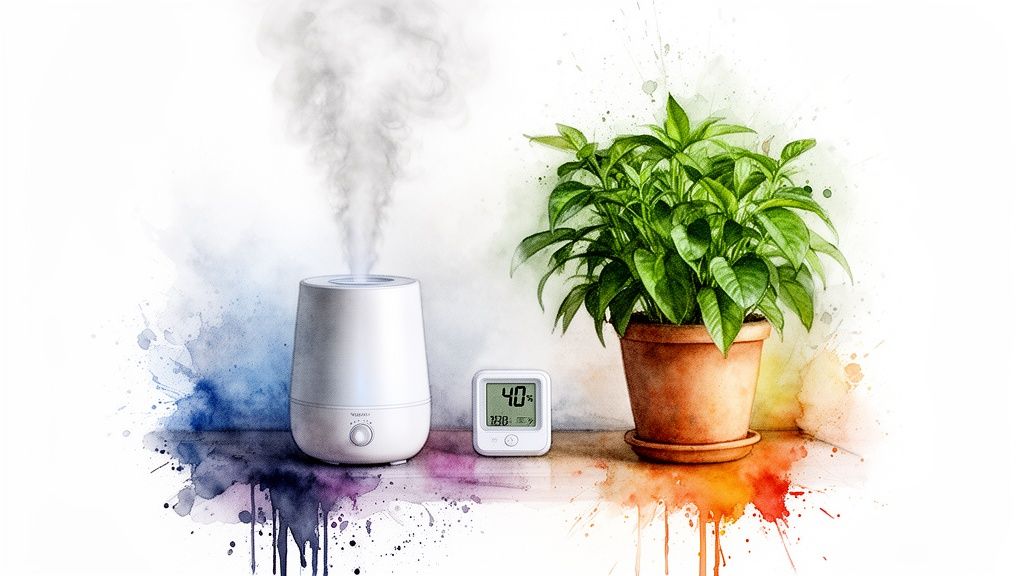
The ideal indoor humidity range is between 30% and 50%. This is the sweet spot—comfortable for our bodies but inhospitable to mould and dust mites. A simple digital hygrometer, which often comes built into modern air quality monitors, is an essential tool for knowing exactly where your home stands.
Choosing and Maintaining a Humidifier
To combat our winter dryness, a humidifier is almost a necessity here. But choosing the right one and, critically, maintaining it properly is key. A neglected, dirty humidifier can quickly become a source of mould and bacteria, doing far more harm than good.
Here are your main options:
- Evaporative Humidifiers: These use a fan to blow air through a wet wick filter. They're self-regulating (they won't over-humidify a room) and generally affordable. The trade-off is that you must replace the wick filter regularly to stop it from turning into a mould farm.
- Ultrasonic Humidifiers: Using high-frequency vibrations, these create a cool mist. They're very quiet but can disperse a fine "white dust" (minerals from your tap water) unless you use distilled or demineralized water.
- Whole-Home Humidifiers: Integrated directly with your furnace, these are the most convenient, "set-it-and-forget-it" solution. They require professional installation and annual maintenance, but they're incredibly effective at keeping your entire house comfortable during our long heating season.
No matter which type you choose, daily water changes and weekly cleanings are essential. This isn’t a suggestion; it's a rule. Treating your humidifier like the health appliance it is ensures you're adding clean, healthy moisture to your air, not just another pollutant. It’s a small bit of winter discipline that pays off all season long.
A Seasonal Guide for Year-Round Clean Air
Living in Edmonton means adapting to our intense seasons. We don't wear a Fringe t-shirt to the Silver Skate Festival, and the same one-size-fits-all thinking just doesn't work for the air inside our homes. A truly effective plan for indoor air quality improvement is one that follows the calendar, shifting focus as the weather changes outside our windows.
This isn't about adding a dozen new chores to your to-do list. It’s about building a few key habits into the natural rhythm of the year, from the big melt in spring to the day we finally crank the furnace on for good.
Summer: The Wildfire Smoke Defence
When the summer sun hangs in the sky for 17 hours a day, our focus shifts from keeping heat in to keeping smoke out. Wildfire season has become our new reality, and preparing for it is no longer optional.
This is the season to be proactive. Before the smoke rolls in, take a few minutes to check the seals on your windows and doors. A bit of fresh weather stripping is a small investment that pays huge dividends by keeping that fine particulate matter from seeping inside.
When an air quality advisory hits, the game plan is simple:
- Seal the Home: Keep your windows and doors shut as much as you can. It sounds obvious, but it's the first and most important line of defence.
- Run Air Purifiers on High: Don't be shy. This is exactly what your HEPA filter was made for. Run it in whatever room you're spending the most time in—especially your bedroom at night—to create a clean-air sanctuary.
- Use Your Air Conditioning Wisely: If you have central AC, set it to recirculate the indoor air. This stops it from pulling in more smoky air from outside. And don't forget that furnace filter—it's working double-duty now.
Winter: The Sealed-In Sanctuary
Once we hit that true "Edmonton cold"—you know the kind, below -20°C—our homes become sealed environments for months on end. The challenge flips from filtering outside air to managing the pollutants and dryness we generate inside.
Winter is all about two things: humidification and ventilation. The prairie air is bone-dry, and our furnaces make it even drier. Your goal should be to keep indoor humidity between 30-50% using a well-maintained humidifier. This simple act can save your sinuses, skin, and even your hardwood floors.
Ventilation is trickier. No one wants a blast of -30°C air. Use your home's mechanical systems: run your Heat Recovery Ventilator (HRV) for an hour in the morning and evening, and always, always use your bathroom and kitchen fans to vent moisture and cooking fumes directly outside.
Spring and Fall: The Seasonal Resets
These shoulder seasons are our chance to prepare for what’s next. Think of them as the bookends to our more extreme seasons, perfect for tackling annual maintenance.
Spring's Big Melt:
As the snow finally vanishes and the river valley trails start to dry out (hello, mud season), a new airborne threat emerges: allergens. Pollen from trees and grasses, plus mould spores from all that melting moisture, can really kick up. This is the perfect time for a deep clean—wash the curtains, wipe down surfaces, and clear out the dust that settled all winter. The transition can be unpredictable, as our guide to the weather in Edmonton in March often highlights.
Fall's Fresh Start:
Before the first big snowfall, it’s time for an air quality reset. Taking care of a few key tasks now will set you up for a much healthier winter lockdown.
Take an hour on a crisp fall weekend to tackle this short checklist. It's one of the best things you can do to prepare your home for the long winter ahead, ensuring you're breathing cleaner air from the very first day the furnace kicks in for good.
- Change Your Furnace Filter: Start the heating season with a fresh, high-quality filter (MERV 11 or 13 is a great target). Your furnace is about to become your home’s lungs for the next six months.
- Clean Your Humidifier: If you put it away for the summer, give your humidifier a thorough cleaning with vinegar and water before its first use. You don't want last season's gunk circulating.
- Check HRV Filters: Pull out and clean the filters on your HRV so it’s ready for winter duty.
By aligning our actions with the seasons, managing our home's air becomes a natural part of our Edmonton lifestyle—not just another thing to worry about.
Edmonton Seasonal IAQ Checklist
This table breaks down the primary challenges and action items for each of Edmonton's distinct seasons, helping you stay on top of your indoor air quality year-round.
| Season | Key Challenge | Primary Action Items |
|---|---|---|
| Winter | Dryness, trapped pollutants | Run humidifier (30-50% RH), use HRV/exhaust fans daily, check furnace filter monthly |
| Spring | Allergens (pollen, mould) | Deep clean home, wash curtains, ensure proper drainage away from foundation |
| Summer | Wildfire smoke (particulates) | Check window/door seals, run HEPA purifiers, recirculate AC, replace furnace filter |
| Fall | Prep for heating season | Install a new MERV 11-13 furnace filter, clean humidifier & HRV filters |
Keeping these simple, seasonal tasks in mind will help you breathe easier and healthier, no matter what the Edmonton weather throws at you.
Common Questions About Edmonton Air Quality
We've covered a lot of ground, from filtration to source control. But theory is one thing, and the reality of dealing with a dusty furnace room or a smoky sky is another. Practical questions always pop up.
Here are some of the most common ones I hear from fellow Edmontonians trying to clear the air in their own homes.
Are Houseplants Enough to Clean My Air?
I love my houseplants, but I don't rely on them to do the heavy lifting during a major air quality event like wildfire season. While they're fantastic for a sense of well-being and can handle some VOCs, their ability to remove fine particulate matter is tiny compared to a mechanical filter.
Think of them as a great supporting player, not the star of your air quality show. Your main defence against high levels of PM2.5 will always be a high-quality filter, especially a HEPA air purifier.
How Often Should I Change My Furnace Filter?
For most of the year, checking your furnace filter every 90 days is a solid baseline. But here in Edmonton, we've got two seasons that demand more attention.
First, during wildfire smoke season, you absolutely need to check it monthly. You'll be shocked at how fast it gets clogged with a fine, grey, sooty dust. Second, make it a non-negotiable fall habit: start the heating season with a fresh, high-quality filter. Aiming for a MERV 11 or MERV 13 is a great target to ensure you're trapping as much dust and dander as possible once the house is sealed up for months.
Is It Worth Getting My Air Ducts Cleaned?
This is a big one, and the honest answer is, "it depends." For most newer homes without pets or severe allergy sufferers, routine duct cleaning probably isn't necessary, provided you're diligent with changing your furnace filter.
I tell people to think of professional duct cleaning as a periodic deep clean, not regular maintenance. It's most beneficial after a major renovation that created a ton of dust, when you first move into an older home, or for households where someone has significant respiratory sensitivities.
Can I Just Build a DIY Corsi-Rosenthal Box?
Absolutely! The Corsi-Rosenthal box is a fantastic, cost-effective DIY solution that punches way above its weight. It's incredibly effective at filtering airborne particles, including the nasty fine particulates from wildfire smoke. It’s a perfect example of practical, Edmonton-style ingenuity.
The main trade-offs are aesthetics and noise—they aren't as sleek or quiet as a polished commercial unit. But in terms of pure air-cleaning performance, a well-built box fan strapped to four or five MERV 13 filters can compete with purifiers that cost hundreds of dollars more. They're an excellent option if budget is your top priority.
Improving your home's air quality is a key part of our overall approach to health and wellness in Edmonton.
At Edmonton Wellness Guide, we're committed to providing practical, evidence-based advice that helps you thrive right here in our city. For more locally-focused wellness strategies, visit us at https://www.edmontonwellnessguide.com.
Related Reading
- Why Does Smoke Season Affect Outdoor Fitness Edmonton: The Science…
- Indoor Cycling vs Outdoor Biking Edmonton: Which Works Better…
- How to Stay Active During Edmonton’s Winter Smoke Season: A…