Let's be real for a moment. That generic advice you read online about taking a "calm, meditative walk in nature" to ease your anxiety? It just doesn’t land the same when it’s February, the wind chill is flirting with -40°C, and getting your winter gear on feels like a workout in itself.
We Edmontonians live a life of extremes, and our approach to mental wellness has to reflect that.
For more on this, see our edmontonian healthy food guide. For more on this, see our edmontonian healthy food guide.
Tackling Anxiety Like An Edmontonian
Our anxiety has a distinctly local flavour. It’s the low-grade dread that sets in when the deep freeze arrives for good, the frantic pressure to cram every possible activity into our short, glorious summers, and the oppressive haze when wildfire smoke blankets the city. It’s the unique challenge of trying to wind down for bed when the sun is still blazing at 10:15 p.m., completely scrambling our internal clocks.
Generic tips often fail us because they don’t account for our reality. The goal isn't to follow a one-size-fits-all plan but to build a flexible toolkit that works during a dark, -30°C winter day just as well as it does on a bright, smoky summer evening.
Our Seasons, Our Stress
The long, dark winters can easily trigger or worsen symptoms of seasonal affective disorder (SAD), a very real challenge at our latitude. This isn't just the "winter blues"; it’s a biological response to a profound lack of light. If you want to dive deeper, you can learn more about what seasonal affective disorder is and how it specifically impacts us here in the north.
For more on this, see our winter light guide. For more on this, see our beat winter blues guide.
Then, summer arrives with its own set of pressures. The non-stop daylight and festival season energy—from Folk Fest to the Fringe—can feel exhilarating, but it can also lead to burnout and social exhaustion if we aren't careful. Acknowledging these seasonal realities is the first step toward building a mental health strategy that actually works for us.
You can't fight an Edmonton winter or an endless summer day, but you can learn to work with them. The goal isn't to eliminate anxiety but to build resilience that's as tough as someone who willingly walks to the LRT when it's colder than Mars.
For more on this, see our winter light guide.
The visual below highlights the core challenges we face and the toolkit we'll build to manage them, season by season.
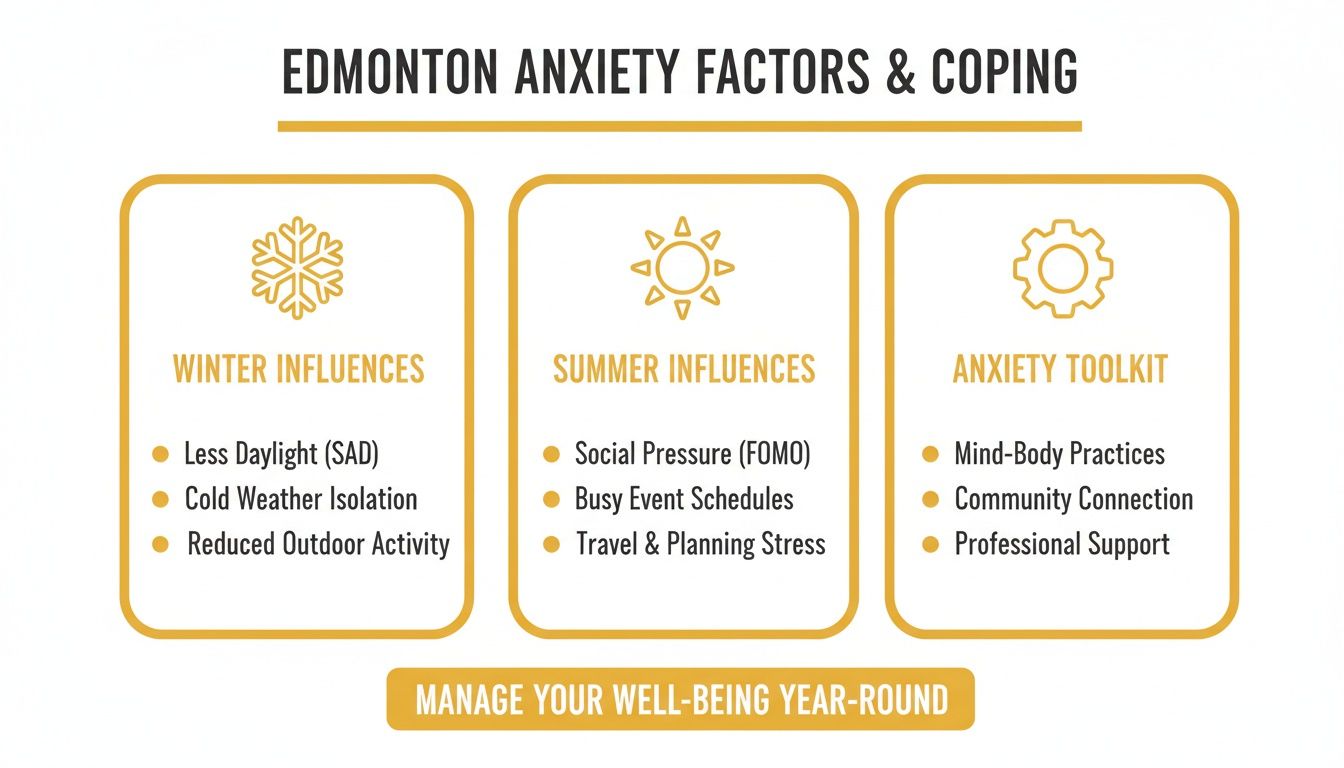
This guide is designed to move beyond one-size-fits-all advice and get into what helps Edmontonians thrive, no matter what the forecast says.
Your Edmonton-Specific Anxiety Management Toolkit
Think of this as your quick-reference guide. These are proven anxiety-management strategies, adapted for the realities of life at 53.5°N latitude.
| Strategy | Winter Adaptation (-20°C & Dark) | Summer Adaptation (Long Days & Smoke) | Why It Works For Us |
|---|---|---|---|
| Movement | Indoor HIIT, mall walking (WEM is 5km a loop!), cross-country skiing in the River Valley, home yoga. | Early morning or late evening runs/walks to avoid heat. Indoor gym sessions when smoke is bad. | Keeps endorphins flowing when outdoor access is limited or unpleasant. |
| Light Exposure | 10,000 lux light therapy lamp for 20-30 mins in the AM. A brisk walk at noon on sunny days. | Blackout curtains are non-negotiable. Wear sunglasses in the evening to signal "downtime" to your brain. | Directly combats SAD in winter and helps regulate a confused circadian rhythm in summer. |
| Nutrition | Vitamin D supplements (1000-2000 IU). Warm, grounding foods like soups and stews. | Hydration is key. Lighter meals that don't require a hot oven. Focus on local produce from farmers' markets. | Supports mood-regulating neurotransmitters and energy levels through seasonal extremes. |
| Social Connection | Schedule intentional indoor meetups (coffee shops, board game cafes). Join a winter sports league. | Patio season! Festivals. River Valley picnics. Leverage the long days for connection. | Fights the isolation of deep winter and the potential for "fear of missing out" (FOMO) in summer. |
This isn't about doing everything at once. It's about having the right tool ready for the right season, so you're responding to your environment instead of just enduring it.
Move Your Body To Beat Anxiety In Any Weather
We’ve all heard it: the river valley is Edmonton’s gym. It's a great sentiment, but let’s be real—for about six months of the year, that gym is either a sheet of ice, buried in snow, or just dangerously cold. Then summer hits, and it's glorious one day and choked with wildfire smoke the next. Relying only on perfect weather for outdoor activity isn’t a strategy; it's just setting yourself up for failure.
The goal isn't to become a hardcore athlete. It’s about finding sustainable ways to move your body consistently, because the science is crystal clear: physical activity is one of the most powerful, natural tools we have for dialing down both the physical and mental symptoms of anxiety.
Winter Movement When You Don't Want To Leave The House
When it’s truly “Edmonton cold”—that special kind of cold below -20°C where your eyelashes start to freeze—the absolute last thing you want to do is go outside. Just the friction of getting layered up can feel exhausting. This is where we have to get creative and give ourselves permission to stay indoors without giving up.
A few practical options that don’t require a pricey gym membership:
- City Rec Centres: Drop-in fitness classes at places like the Meadows or Kinsmen are fantastic. You get a structured workout plus the low-key social connection of just being around other people, which is a mood booster in itself.
- Mall Walking: It might sound a bit silly, but a few laps around West Edmonton Mall or Southgate Centre is a legitimate way to get your steps in. The environment is warm, bright, and safe from icy sidewalks.
- At-Home Workouts: There are thousands of free, high-quality workout videos online for every fitness level. A 20-minute bodyweight circuit or a yoga session in your living room is infinitely better than doing nothing at all.
The key here is to lower the barrier to entry. If the thought of driving across the city in a snowstorm is stressful, it completely defeats the purpose. On the coldest, darkest days, just pick the path of least resistance.
Leveraging Our Short But Glorious Summers
When summer finally arrives, there's this immense pressure to do everything. Those 17-hour days are an incredible gift, but they can also be overwhelming. The trick is to weave movement into your life in a way that feels restorative, not like just another chore on your to-do list.
Instead of feeling guilty for not running a half-marathon, try something gentler:
- Evening Ravine Walks: A post-dinner stroll through Mill Creek Ravine, when the light is golden and the air is cooler, is one of Edmonton's simplest and greatest pleasures.
- Neighbourhood Bike Rides: Explore the beautiful streets of Glenora or the paths winding around Windermere. It’s a great way to see more of the city and get your heart rate up without it feeling like a grueling workout.
- Mindful Smoke-Day Planning: When the air quality is poor, don't push it. Pushing your lungs on a smoke day is counterproductive. This is the perfect time to head to an indoor climbing gym, try a spin class, or revisit those at-home workouts you relied on back in January.
Movement is one of the most effective ways to manage anxiety naturally, and on those perfect days, we have an incredible landscape for it. As we've explored before, the river valley is your gym, and it's free. But having a solid backup plan for the other days is what builds true resilience.
Consistency Over Intensity
When it comes to anxiety management, a brisk 20-minute walk every day is far more effective than one punishing two-hour workout on a Sunday. Why? Because short, regular bursts of activity release endorphins, reduce muscle tension, and give your racing mind something else to focus on. It breaks the anxiety cycle.
In Alberta, regular physical activity is a proven, low-cost way to reduce anxiety symptoms. Yet our long, cold winters contribute directly to lower activity levels and higher rates of low mood. It's no surprise that, statistically, only about 16%–25% of Canadians consistently meet recommended activity levels. To combat this, local public health initiatives have found that winter-specific adaptations—like promoting indoor community centre classes, mall walking, and skating at community rinks—are crucial. In fact, some Alberta community programs report attendance increases of 20%–40% when they offer warmed, accessible indoor options during the winter. You can discover more insights about these findings on how Canadians stay active.
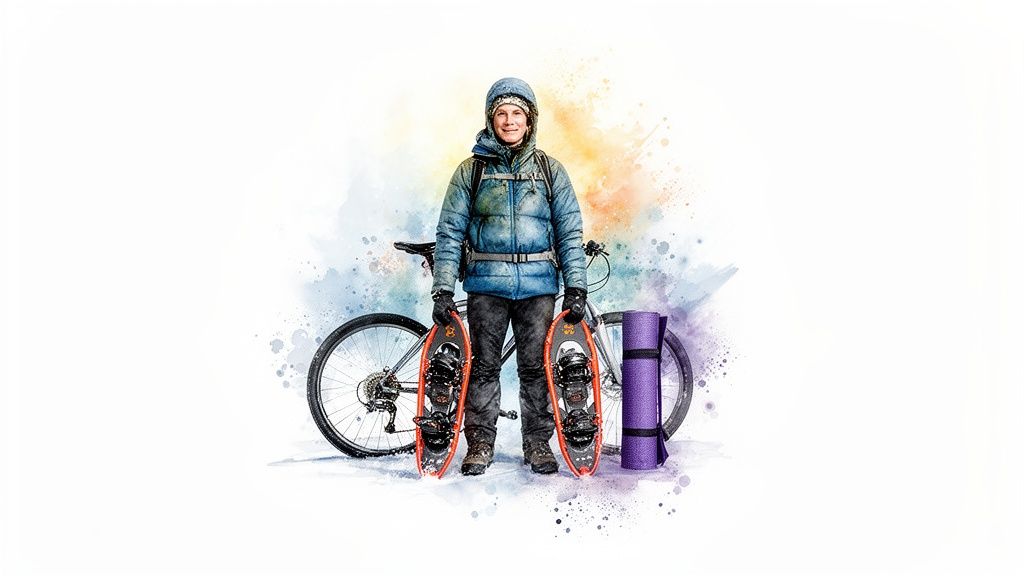
The best workout for anxiety is the one you’ll actually do. If that means snowshoeing through Terwillegar Park one weekend and doing a dance workout in your basement the next, that’s a perfect Edmonton strategy.
Ultimately, it’s all about adapting. We’re Edmontonians—we know how to layer up, how to pivot when the weather turns, and how to make the most of what we’ve got. Applying that same mindset to how we move our bodies is the key to managing anxiety, no matter what the forecast says.
Practical Mental Tools That Actually Work
When your mind starts racing—whether you're stuck in traffic on the Whitemud or waiting for a stressful meeting to start in some downtown tower—you don’t need complex theories. You need simple, practical tools that cut through the noise right now.
Forget the wellness jargon; this is about building a mental first-aid kit with a few reliable techniques that genuinely work. It's about having a couple of go-to exercises in your back pocket that can ground you when you feel that familiar spike of anxiety. These are skills you can use anywhere, anytime, without anyone even knowing.
For more on this, see our breathing exercises anxiety guide. For more on this, see our breathing exercises anxiety guide.
Grounding Yourself in the Moment
Grounding is a straightforward technique to pull your mind out of an anxious spiral and back into the present. It’s incredibly effective when you feel overwhelmed by "what-if" thoughts. The most common method is the 5-4-3-2-1 technique.
Here’s how it works, no matter where you are:
- 5: Acknowledge FIVE things you can see. Your computer monitor, a half-empty coffee mug, the snow falling outside, the texture of your desk.
- 4: Acknowledge FOUR things you can touch. The fabric of your jeans, the smooth surface of your phone, the warmth of your skin.
- 3: Acknowledge THREE things you can hear. The hum of the furnace, a distant siren, the clicking of your own keyboard.
- 2: Acknowledge TWO things you can smell. The faint scent of coffee, the hand sanitizer on your desk.
- 1: Acknowledge ONE thing you can taste. The lingering flavour of your lunch or the mint from your gum.
This exercise forces your brain to focus on your immediate sensory experience, interrupting the runaway train of anxious thoughts. It brings you back to your body and your environment, which is a powerful way to manage anxiety on your own terms.
Breathing to Reclaim Your Calm
When we're anxious, our breathing often becomes shallow and rapid, which only signals more panic to our nervous system. Intentionally slowing down your breath is one of the fastest ways to reverse this cycle. A simple and effective technique is box breathing.
Imagine drawing a box in your mind:
- Breathe in slowly through your nose for a count of four.
- Hold your breath for a count of four.
- Exhale slowly through your mouth for a count of four.
- Hold your breath at the end of the exhale for a count of four.
Repeat this cycle three or four times. You can do this while waiting for the LRT at Southgate, during a tense conversation, or before a big presentation. It works because it forces a slower, more deliberate breathing pattern, which activates the body's natural relaxation response.
For more ideas on handling pressure, check out our guide on how to manage work stress.
For more on this, see our manage stress edmonton guide. For more on this, see our manage stress edmonton guide.
Why These Self-Directed Tools Are So Crucial Here
Let's be honest: accessing formal mental health services in Alberta can be a challenge. Long waitlists and costs are real barriers for many of us. That’s why building a toolkit of effective, self-directed mental exercises isn't just a "nice-to-have"—it's an essential part of managing day-to-day anxiety.
Mindfulness and brief cognitive behavioural therapy (CBT) techniques are proven, effective self-management tools that can reduce anxiety symptoms by 20%–40%. These aren't just feel-good exercises; they have a measurable impact on your well-being.
Recent Canadian data shows that roughly 41% of adults with a diagnosed mental health disorder reported their needs were partially or completely unmet. This gap is why learning how to manage anxiety with tools you can use on your own is so important for building resilience.
These mental tools don't replace professional help when it's needed, but they empower you to take immediate action. They give you a sense of control when things feel out of control, which is often the very heart of anxiety. They are the practical, everyday skills that help us get through another long winter or a frantic summer, one calm breath at a time.
Building Your Community to Find Connection
Let’s be direct about something: Edmonton winters can feel isolating. When it’s dark by 4:30 p.m. and the thought of bundling up just to go anywhere feels like a monumental effort, it’s easy to retreat into yourself. But connection is one of the most powerful, natural ways to manage anxiety, and we can’t afford to let the cold win.
Generic advice like "call a friend" is fine, but it doesn't help when you feel like you need to build a network from scratch. Here, we're talking about tangible ways to find your people right here in our city, because having a community to lean on is non-negotiable for getting through the highs and lows of life at this latitude.
Finding Your Tribe Beyond the Usual Places
Building a community often means putting yourself in new situations, which, let's face it, can feel anxiety-inducing in itself. The trick is to find low-pressure environments built around a shared interest. This shifts the focus from the intimidating goal of "making friends" to simply participating in something you already enjoy.
A few Edmonton-specific ideas to get you started:
- Embrace Festival Culture as a Volunteer: We’re called Festival City for a reason. Volunteering for the Fringe Festival or Folk Fest isn't just about getting a free pass; it’s an instant community. You’re working side-by-side with like-minded people toward a common goal—it’s a perfect recipe for connection.
- Join a Niche Club: Think beyond a standard gym. Maybe it’s a run club that meets at the Kinsmen Sports Centre, a board game group that gathers in a cafe on Whyte Ave, or a drop-in pottery class in a neighbourhood like Strathcona or Oliver. The activity itself becomes the icebreaker.
- Use the River Valley Together: Even a solo activity can become social. Groups meet for everything from snowshoeing in Terwillegar Park to cycling the endless trails. A quick online search reveals dozens of local clubs looking for new members of all skill levels.
The key is to start small. You don’t need to become a social butterfly overnight. Just showing up consistently to one new thing a month can begin to weave those crucial threads of connection.
The Workplace Connection and Financial Stress
We can’t talk about anxiety and community without addressing the place many of us spend most of our waking hours: work. A supportive workplace can be a massive protective factor for our mental health. On the flip side, a toxic one can be a primary source of anxiety.
Let's also be honest about another major stressor—money. Worrying about bills, especially with the rising cost of living in our city, is a significant trigger for anxiety for a huge number of us. It’s a quiet stressor that can feel intensely isolating.
The data backs this up. National surveys report that 40% of workers live with constant stress, and for 49% of them, money is the top source. Community peer-support groups have been shown to reduce self-reported anxiety by around 20% in just three months. Meanwhile, employer-provided options like flexible scheduling and financial wellness workshops can decrease employee-reported financial anxiety by 10%–30%. You can explore the full report on how financial stress impacts Canadian workers for more context.
Building Resilience Through Accessible Community
The goal here is to foster genuine ties that act as a buffer against stress. This doesn't have to be expensive or complicated. In fact, some of the most effective ways to build community are low-cost or completely free.
True community isn't about having a hundred acquaintances; it's about having a few people you know you can count on when you're struggling—whether it’s because of a brutal cold snap or a tough week at work.
Here are a few accessible ways to build those ties:
- Neighbourhood Community Leagues: Most Edmonton neighbourhoods have one. They are absolute hubs of local activity, from skating rinks in the winter to community gardens in the summer.
- Edmonton Public Library Events: The library offers far more than just books. Check out their free workshops, author talks, and classes on everything from coding to crafting.
- Support Local: Becoming a regular at a local coffee shop in Ritchie or a bookstore in Westmount creates a sense of familiarity and casual connection that can make a huge difference in your daily life.
Building a community is an active process, and it takes time. It’s about planting seeds and having the patience to watch them grow. But the effort pays off, creating a support system that is foundational to managing anxiety and truly thriving in our unique and wonderful city.
Nourish Your Nerves With Food, Sleep, And Light
When you’re trying to manage anxiety, it's easy to get lost in complex techniques. But honestly, some of the most powerful work is in getting back to the absolute basics: what you eat, how you sleep, and the light you let into your eyes.
Here in Edmonton, these fundamentals aren't just nice-to-haves. They’re non-negotiable. Our extreme environment is constantly working against our body’s natural rhythms, and shoring up these foundations is your first line of defence.
Let's skip the preachy influencer tone. This isn't about a perfect diet or a flawless sleep schedule. It's about making small, realistic adjustments that give your nervous system the support it desperately needs.
Fuelling a Calmer Mind, The Edmonton Way
Food is fuel. When your body is running on fumes—or jittery from too much caffeine—your anxiety will always feel worse. The goal isn’t some restrictive diet; it’s about giving your body stable energy to prevent the blood sugar crashes that can mimic or trigger a spiral of anxious thoughts.
We don't need expensive superfoods flown in from across the globe. We need simple, affordable staples that actually work. Think about building your meals around these:
- Complex Carbohydrates: Oats, root vegetables, and whole-grain bread are your friends. They provide a slow, steady release of energy that helps stabilize your mood and prevents that "hangry" feeling that so easily bleeds into anxiety.
- Lean Proteins: Things like eggs, lentils, chicken, and Greek yogurt are crucial for building the neurotransmitters (like serotonin) that regulate how you feel. A protein-rich breakfast can set a calmer tone for the entire day.
- Healthy Fats: Foods rich in omega-3s, like salmon and walnuts, have been shown to help reduce inflammation and directly support brain health.
And let's have an honest chat about caffeine. A coffee from a local spot on a cold winter morning is one of life’s simple joys. But if you’re already running anxious, that third cup can easily tip your nervous system into overdrive. Try swapping it for a decaf or herbal tea and just see how you feel.
Mastering Light And Sleep At Our Latitude
Our relationship with light is… complicated. In December, we get a measly seven hours of daylight. Fast forward to June, and we’re flooded with over 17 hours of it, with the sun still hanging around when we should be winding down.
This extreme swing plays havoc with our circadian rhythm—the internal clock that tells us when to feel sleepy and when to feel awake. When that clock is out of sync, your ability to regulate your emotions is one of the first things to go.
For our long, dark winters:
- Get a SAD Lamp: A 10,000-lux light therapy lamp is a game-changer. Seriously. Using it for 20-30 minutes first thing in the morning helps reset your internal clock, providing a clear signal to your brain that the day has started.
- Chase the Midday Sun: Even on a frigid day, a quick 15-minute walk around noon—when the sun is at its highest—can make a surprising difference to your mood and energy.
For our bright, endless summers:
- Blackout Curtains Are Essential: This isn’t a luxury; it’s critical infrastructure for sleep in this city. Blocking out that 10 p.m. sunlight is the only way to signal to your brain that it's time to produce melatonin and prepare for rest.
- Create an "Artificial Sunset": An hour before bed, dim the lights in your home and put away your phone. This helps mimic the natural winding-down process that our environment simply isn't providing.
Managing sleep here can be a real challenge. For a more detailed look, you can learn more about how our city makes rest complicated and what to do about it.
The Vitamin D Discussion
If you live in Edmonton, supplementing with Vitamin D in the fall and winter isn't really optional. Our northern latitude means we simply can't produce enough of this crucial vitamin from sun exposure for about half the year.
Low Vitamin D levels are strongly linked to low mood and increased anxiety. For most adults here, supplementing with 1,000 to 2,000 IU daily from October to April is a simple, evidence-based way to support your mental well-being.
Think of these pillars—food, sleep, and light—as the foundation of your house. Without a solid foundation, everything else you build on top will feel shaky. By focusing on these basics and adapting them to our local reality, you give yourself a stable base to handle whatever an Edmonton season throws at you.
Your Edmonton Anxiety Resource Guide
Knowing you need a hand is one thing; knowing where to find it is a whole other challenge. When the strategies you're trying on your own aren't cutting it, or you just need more support, it helps to have a list of real, local resources. This isn't an exhaustive directory, but it's a solid starting point with options right here in our city.

Immediate and Low-Barrier Support
Sometimes you just need to talk to someone right now, without navigating a waitlist or worrying about a fee. These services are built for exactly that.
- 211 Alberta: Think of this as the city's switchboard for community and social services. You can call or text 211 anytime to get connected to a massive range of resources, including mental health support and counselling. It’s free and confidential.
- AHS Mental Health Help Line: Available 24/7 at 1-877-303-2642, this line offers support, information, and referrals for any Albertan dealing with mental health concerns. They can help you figure out what to do next.
These resources are invaluable because they remove the usual barriers. You don't need a doctor's referral or an appointment; you just need a phone. For many people, they are a crucial first step toward finding their footing.
Finding Ongoing Help and Community
Managing anxiety is often a long game that requires consistent support. That might mean formal therapy, but it can also mean finding your people and learning new skills alongside others who just get it.
Here are a few avenues for more structured support in Edmonton:
- Access 24/7 (AHS): Located at Anderson Hall on the Royal Alexandra Hospital campus, this service is a central hub for mental health and addiction support. You can walk in for an assessment and get pointed toward the right AHS programs for you.
- Momentum Walk-In Counselling: This non-profit offers single-session counselling with no fees. It’s a fantastic option if you need to talk through a specific issue with a professional but aren't ready to commit to ongoing therapy.
- Local Groups and Clubs: Never underestimate the power of connection. Finding a local mindfulness group, a book club in Strathcona, or even a community league walking group can provide the routine and peer support that makes a massive difference, especially during our isolating winters.
Knowing you're not the only one feeling this way is incredibly powerful. The goal is to find a support system that fits your life, whether that’s a therapist’s office or a shared path in the river valley.
Our long winters can be particularly tough on mental health, often blending with seasonal depression. If you suspect the dark days are getting to you, you might find our guide on how to deal with seasonal depression helpful.
Reaching out is a sign of strength. We Edmontonians are a resilient bunch, but we’re also a community. These resources are here to help us all weather the storms—both literal and figurative—together.
At Edmonton Wellness Guide, we're committed to providing practical, locally relevant health information to help you thrive in every season. Discover personalized wellness plans and more at https://www.edmontonwellnessguide.com.
Related Reading
- How to Reduce Inflammation Naturally: An Edmonton Guide
- How to Manage Stress at Work: An Edmonton Guide
- How to Boost Immunity Naturally Through an Edmonton Year