
Let's get straight to it. Getting a handle on inflammation isn’t about some complicated wellness trend. The fundamentals are simple: eat more real food, move your body, manage your stress, and get decent sleep. It's about piling more colourful vegetables onto your plate, taking a walk in the river valley, and having a consistent bedtime. These small habits build a powerful defence against that low-grade, run-down feeling.
For more on this, see our prevent seasonal wellness guide. For more on this, see our prevent seasonal wellness guide.
Tackling Inflammation, The Edmonton Way

Let’s be honest. Living in Edmonton asks a lot of our bodies. We swing between brutally cold, dark winters where -20°C is just another Tuesday, and glorious but frantic summers with 17 hours of daylight. Our bodies are in a constant state of adaptation, and that relentless adjustment can create a low-grade, persistent hum of inflammation.
For more on this, see our winter light guide. For more on this, see our summer winter running guide. For more on this, see our winter light guide. For more on this, see our summer winter running guide.
That feeling of being perpetually drained, achy, or just "off"? It’s not always in your head. It can be a very real sign of chronic inflammation, a state where your body's internal alarm system gets stuck in the "on" position. This isn't some trendy wellness buzzword; it’s a physiological process heavily influenced by our distinct Edmonton lifestyle.
Our City, Our Challenges
Just think about our environment for a minute. The long, dark winters often mean less sun exposure, which can tank our Vitamin D levels and throw our internal body clocks (our circadian rhythm) completely out of whack. This isn't just a mood-killer; it's a direct driver of inflammation.
Then, just as we crawl out of hibernation, we’re hit with the summer festival frenzy—long days at Folk Fest, late nights at the Fringe, and a desperate scramble to cram an entire year's worth of outdoor living into a few short months. Our sleep schedules get obliterated.
And we can’t ignore the smoke. Summer now comes with the very real threat of wildfire haze blanketing the city, which is a direct inflammatory trigger. To get a better sense of this, you can learn more about wildfire smoke health effects in our guide. All these factors—the extreme light shifts, the social calendar, the environmental assaults—can really pile up.
This guide is about acknowledging these realities and finding ways to work with them, not against them. It’s about building resilience with small, sustainable habits that actually fit into a life lived in YEG, from Windermere to the Highlands.
A Practical YEG Approach
Forget about chasing expensive, hard-to-find "superfoods" or adopting workout routines that make zero sense when it's -30°C. The goal here is to give you practical, evidence-informed strategies that actually work for us.
We’re going to focus on things that matter right here at home:
- Accessible Nutrition: How to build an anti-inflammatory plate with ingredients you can find at any Superstore, Save-On-Foods, or local farmers' market.
- Year-Round Movement: Using our incredible river valley as a tool, whether that’s a snowy walk in Mill Creek Ravine or a summer bike ride along the water.
- Lifestyle Rhythms: Simple ways to manage sleep and stress despite our city’s extreme seasonal swings.
This is about taking back a bit of control and learning how to feel better, right here where we live.
To get you started, here's a quick reference table with some simple, high-impact changes tailored for life in our city.
Your Edmonton Anti-Inflammation Quick Start
| Action | Why It Works in Edmonton | Easy First Step |
|---|---|---|
| Get 20 Mins of Morning Light | Our extreme light shifts disrupt circadian rhythms. Morning light helps reset your internal clock, which regulates inflammatory processes. | Drink your morning coffee or tea next to a window, even on a cloudy day. In winter, a light therapy lamp is a game-changer. |
| Eat One More Colourful Vegetable | We often default to heavier, beige foods in winter. Adding colour means adding antioxidants and polyphenols that fight inflammation. | Add a handful of spinach to your eggs, toss some frozen berries in a smoothie, or add bell pepper strips to your lunch. |
| Walk a River Valley Trail | Movement is a powerful anti-inflammatory. The valley offers free, accessible options year-round, from paved paths to quiet ravines. | Park at Hawrelak and do the 2.5 km loop. It’s mostly flat and a perfect, low-commitment start. |
| Prioritize Omega-3s | Omega-3 fatty acids directly combat inflammation. Many people don't get enough, especially with diets heavy in processed foods. | Add fatty fish like salmon to your dinner once a week, or sprinkle flax or chia seeds on your oatmeal or yogurt. |
| Filter Your Indoor Air | Wildfire smoke is a significant source of airborne inflammatory particles that get inside our homes. | Get a good quality portable HEPA filter for your bedroom. Run it at night while you sleep, especially during smoke season. |
Think of these as your starting lineup. You don’t have to do everything at once. Just picking one and sticking with it for a week can start to shift the balance in your favour.
Eating for Our Seasons: An Anti-Inflammatory Diet, Edmonton-Style

When you read about anti-inflammatory diets, the advice can feel a little… exotic. Mangoes in December, fresh goji berries, ingredients that cost a fortune and are only found at one specialty store across town.
Let's ground this conversation right here in Edmonton. You absolutely do not need to hunt down rare superfoods to reduce inflammation; you just need to know what to look for at the Old Strathcona Farmers' Market, Superstore, or H&W Produce.
The core idea is simple: eat more whole foods, especially plants, and fewer highly processed ones. It’s not about restriction or punishing rules. It's about adding in powerful, nutrient-dense foods that actively fight inflammation on your behalf.
The Mediterranean diet is often held up as the gold standard, and for good reason. It’s built on a foundation of fruits, vegetables, whole grains, olive oil, and fish. While we might not have access to fresh-caught Mediterranean sea bass, we can absolutely adapt its principles to our northern climate.
In fact, the research is incredibly solid. Studies have found that following this style of eating can reduce a key inflammatory marker, C-reactive protein (CRP), by a significant margin. This isn't just theory; it’s a measurable, biological change driven by what’s on your plate.
Stocking Your Winter Pantry the Edmonton Way
Our biggest challenge is, of course, the long winter. When the ground is frozen solid and fresh produce is shipped from thousands of kilometres away, it’s easy to fall back on heavy, convenient comfort foods. The key is a well-stocked pantry and freezer.
Instead of thinking about what you can't have, focus on these winter powerhouse ingredients:
- Root Vegetables: Carrots, beets, parsnips, and sweet potatoes are affordable, last for ages, and are packed with anti-inflammatory compounds. Roasting them brings out their natural sweetness and makes for an easy, comforting side dish.
- Frozen Berries: Our local berry season is short but spectacular. Frozen berries—especially blueberries, raspberries, and saskatoons—are picked at peak ripeness, locking in their antioxidants. They are perfect for smoothies, oatmeal, or a simple dessert.
- Quality Grains & Legumes: Think barley from the prairies, steel-cut oats, quinoa, lentils, and chickpeas. These are loaded with fibre that supports a healthy gut, a cornerstone of managing inflammation.
- Healthy Fats: A good quality olive oil is essential. Also, consider adding nuts like walnuts and seeds like flax and chia, which are excellent sources of anti-inflammatory omega-3 fatty acids.
A winter-friendly anti-inflammatory meal could be as simple as a hearty lentil soup made with root vegetables, a salmon fillet with roasted beets and quinoa, or a warm bowl of oatmeal topped with frozen berries and walnuts.
Embracing Our Short but Glorious Summer
When summer finally arrives, we have an incredible bounty at our fingertips. This is the time to lean into fresh, local produce. A Saturday morning trip to a farmers' market—Strathcona, Callingwood, or even a smaller community one—is one of the best things you can do for your health.
During these months, your plate should be overflowing with colour. These vibrant pigments aren't just for show; they represent a diverse array of powerful antioxidants that directly combat cellular stress.
Here’s a practical way to approach it:
- Fill Half Your Plate with Veggies: At every single meal, make half your plate local vegetables. Think crisp cucumbers, vibrant bell peppers, leafy greens, and zucchini.
- Enjoy Seasonal Fruit: Take full advantage of fresh saskatoons, strawberries, and raspberries when they hit the markets. They are inflammation-fighting superstars.
- Grill Smart: Instead of processed meats, try grilling salmon, chicken, or colourful vegetable skewers marinated in olive oil, garlic, and herbs.
An anti-inflammatory diet is a powerful part of a strong immune response. For a deeper dive into this, check out our guide on the best foods to boost your immune system. Eating this way isn't about a fad; it’s about aligning our food choices with the rhythm of our seasons, using the accessible, wonderful ingredients our region has to offer to build a more resilient body.
For more on this, see our boost immunity naturally guide. For more on this, see our boost immunity naturally guide.
The Unsung Heroes: Cereal Fibre and Your Gut
When we talk about anti-inflammatory foods, it’s easy to get caught up in the flashy stuff—the vibrant berries and deep leafy greens. And don't get me wrong, they're fantastic. But there's a quiet, hardworking hero in our pantries that often gets overlooked, and it’s one of the most powerful tools we have for managing inflammation: cereal fibre.
I know, "cereal fibre" doesn't exactly sound exciting. But stick with me, because understanding this connection is a game-changer, especially for us here in Edmonton where hearty, affordable staples are king during our long winters. The health of your gut is directly wired to the level of inflammation throughout your body, and the right kind of fibre is precisely the fuel your gut needs to thrive.
Why Your Gut Is Grand Central Station for Inflammation
Think of your gut as a bustling community of trillions of bacteria. When this community is balanced and happy, it helps regulate your immune system, keeping it calm and preventing it from overreacting. But when it's out of whack, it can send out signals that trigger inflammation everywhere, from your joints to your brain.
This is where fibre comes in. Specifically, the fibre from whole grains like oats, barley, and whole wheat acts as a premium food source for your beneficial gut bacteria. When these good microbes feast on cereal fibre, they produce compounds called short-chain fatty acids (SCFAs). These SCFAs are incredible—they strengthen your gut wall and send signals throughout your body to actively dial down inflammation.
It's a direct, powerful mechanism happening inside you every single time you choose a bowl of oatmeal over a sugary cereal.
The science is surprisingly specific on this. While all fibre is good, research consistently shows that cereal fibre has the strongest link to lower levels of inflammatory markers in the body. It’s not just a vague "eat more fibre" recommendation; the type of fibre really does matter.
Making Cereal Fibre Work for You
So, how do we put this into practice? It starts right at the grocery store. Navigating labels can feel like a chore, but here’s what to look for:
- Check the First Ingredient: The very first item on the list should be "whole grain [name of grain]" or "whole wheat flour."
- Look for the Whole Grain Stamp: That yellow and black stamp is a reliable shortcut to confirm a product is made with a significant amount of whole grains.
- Ignore the Colour: Don't be fooled by brown bread. Some are just white bread with added molasses for colour. Always, always check the ingredients.
Once you have your whole grains, getting them into your meals is easy, especially with our seasons in mind.
- Winter Mornings: There’s nothing better than a warm bowl of steel-cut oats on a dark, frosty Edmonton morning. Top it with some frozen saskatoons and a sprinkle of flax seeds for an extra anti-inflammatory punch.
- Hearty Soups and Stews: Alberta is barley country. Adding a cup of pot barley to a beef or vegetable soup not only makes it more filling and comforting but also significantly boosts its fibre content.
- Simple Swaps: Trade white rice for quinoa or brown rice. Choose whole-wheat pasta. Use whole-grain bread for your sandwiches. These small, consistent changes add up faster than you’d think.
This isn't just about feeling a little better; it's about making a measurable impact on your long-term health using affordable, accessible foods that are perfect for our Edmonton lifestyle.
Movement and Nature: Edmonton’s Natural Medicine

Here in Edmonton, we have something most cities don't: the largest stretch of urban parkland in North America, threaded right through the heart of the city. We often think of "exercise" as something that happens inside a gym, but some of the most powerful anti-inflammatory work happens when we simply move our bodies outside.
This isn’t just a nice idea; the science is solid. Movement stimulates the release of anti-inflammatory molecules from our muscles. When you combine that with time in nature, you have a potent recipe for calming an overactive immune system. The focus isn't on punishing workouts but on finding joy and consistency in using our city’s greatest asset.
Making the River Valley Your Year-Round Ally
The river valley isn’t just for those perfect July evenings. It offers unique opportunities in every season, and learning how to embrace them is the secret to building a sustainable movement habit.
- Winter: When a fresh snowfall blankets the trails, a walk through Mill Creek Ravine is pure magic. It's quiet, crisp, and incredibly peaceful. The key is dressing for it. With a good base layer, a warm mid-layer, and a windproof shell, a -20°C day—what we'd call a pretty standard "Edmonton cold"—can feel invigorating rather than intimidating.
- Summer: On those long, bright evenings, a bike ride from the High Level Bridge down towards Buena Vista Park is a classic Edmonton experience. The only trick is hydration and timing—aim for early mornings or later evenings to avoid the peak sun and heat.
This consistent, positive contact with our natural spaces has a direct biological impact. Recent research shows a clear link between more time in nature and lower levels of multiple inflammatory biomarkers. This suggests that simply being in restorative green spaces can help reduce chronic inflammation, independent of other health habits.
Finding Joy in Movement, No Matter the Weather
Let's be real: our weather throws us curveballs. Between the deep freeze, the spring mud season, and the unfortunate reality of wildfire smoke season, we need a flexible approach.
The goal is consistency, not intensity. A gentle 20-minute walk has more anti-inflammatory benefit over time than one brutal, hour-long workout you can't bring yourself to repeat for weeks. Find something that feels good, and you'll actually stick with it.
When the air quality is poor or the trails are too icy, it's crucial to have indoor alternatives ready. This doesn’t have to mean a pricey gym membership.
Think simple:
- A yoga session in your living room.
- A bodyweight strength circuit.
- Walking the stairs in your apartment or condo building.
- Visiting a city-run rec centre like the Kinsmen or Terwillegar for a swim or a walk on the indoor track.
The point is to have a Plan B so that our uniquely Edmonton challenges don't derail your efforts entirely. Movement is one of the most effective ways to tell your body to turn off the inflammatory alarm bells. You don’t need to be an elite athlete to reap the rewards; you just need to start.
For more inspiration on making our green spaces work for you, check out our guide on how the river valley is your gym and it's free. Embracing what's right outside our door is a powerful and practical step toward feeling better.
Managing Stress and Sleep in the City of Festivals
Let's talk about the Edmonton paradox. We live for our vibrant, jam-packed summer festival season and those magical, endless evenings. But we also endure the long, dark winters that can feel like they'll never end. This extreme swing in daylight and social energy is part of our identity, but it can absolutely wreak havoc on our stress levels and sleep patterns—two of the biggest drivers of chronic inflammation.
Managing this isn't about achieving some perfect, mythical balance. That’s an impossible standard here. It's about building a personal toolkit to find stability amidst the unique pressures of our city and learning to tune into our body's fundamental needs for rest and calm.
When our stress is high and our sleep is poor, the body ramps up production of inflammatory hormones like cortisol. Over time, this constant "on" signal wears us down, contributing to everything from joint pain and fatigue to brain fog. The good news is that we have a surprising amount of control over these factors, even with our wild seasons.
Taming Our Extreme Light Cycles
Our latitude means our internal body clock, or circadian rhythm, is constantly being challenged. This rhythm governs nearly every system in our body, including the immune response. When it’s out of sync, inflammation can creep up. The key is to manage our light exposure, essentially creating our own consistent sunrise and sunset.
Summer Strategy (May – September)
That 10 PM sunset is glorious, but it can make winding down feel almost impossible. Our brains are hardwired to associate light with wakefulness.
- Blackout Curtains Are Non-Negotiable: This is the single most important investment for summer sleep in Edmonton. Your goal is to make your bedroom as dark as a cave.
- Create an "Artificial Sunset": An hour before you want to sleep, start dimming the lights in your home. Kill the bright overheads and switch to lamps.
- Mind Your Screens: The blue light from phones and TVs is particularly disruptive. If you have to be on a screen, at least use the night mode settings.
Winter Strategy (October – April)
In the winter, the challenge flips completely. Waking up in the pitch dark for months on end can contribute to seasonal affective disorder (SAD) and throw our rhythm off in the other direction.
- Embrace a SAD Lamp: Using a light therapy lamp for 20-30 minutes first thing in the morning can mimic the sunrise. It's a powerful tool for resetting your clock and boosting mood and energy.
- Get Outside Midday: Even on a cloudy day, the natural light around noon is far more powerful than indoor lighting. A quick walk in a neighbourhood like Oliver or a loop around the Legislature grounds can make a huge difference.
For a deeper look into this, you can learn more about how to improve sleep in Edmonton and what to do about our city’s unique challenges.
To make this even clearer, here’s how the seasonal strategies break down side-by-side.
Seasonal Rhythm Guide for Edmontonians
Navigating Edmonton's distinct seasons requires a shift in tactics. What works to keep you balanced in the endless light of July is the opposite of what you need in the deep dark of January. This table offers a quick comparison of strategies to help you adapt.
| Challenge | Winter Strategy (Oct-Apr) | Summer Strategy (May-Sep) |
|---|---|---|
| Light Exposure | Use a 10,000 lux SAD lamp for 20-30 mins upon waking. Seek midday sun exposure, even if brief. | Use blackout curtains to create a dark sleep environment. Dim indoor lights 1-2 hours before bed. |
| Sleep Schedule | Maintain a consistent wake-up time, even on dark mornings, to anchor your circadian rhythm. | Stick to a consistent bedtime, even when it's still light out. Avoid long weekend sleep-ins. |
| Stress Management | Find cozy, indoor refuges (like the Muttart). Prioritize social connection to combat isolation. | Schedule downtime between festivals and events. Get out into the river valley to decompress. |
| Energy Levels | Focus on gentle, consistent movement. Don't fight the natural urge to slow down slightly. | Take advantage of the long days for outdoor activity, but be mindful of burnout from over-scheduling. |
Ultimately, the goal is the same year-round: consistency. By actively managing your environment, you provide your body with the stable cues it needs to regulate itself, no matter what the sky is doing.
Finding Calm in a Bustling City
Stress management doesn't require a silent retreat or hours of meditation. It’s about finding small pockets of peace right here in the city. When we're running between the Fringe and Heritage Fest, or just grinding through a tough work week, having a go-to de-stressor is crucial.
Think of it as strategic downtime. Instead of waiting until you're completely burned out, you intentionally build small moments of calm into your day. This proactive approach helps keep cortisol levels in check and prevents inflammation from flaring up.
Here are a few realistic, Edmonton-based ideas:
- A Quiet Moment at the Muttart: Stepping into the tropical pyramid on a bleak November day is an instant mood-lifter. The warmth and greenery are incredibly restorative.
- A Walk in an "Off-the-Beaten-Path" Park: While the main river valley trails get busy, quieter spots like MacKinnon Ravine Park offer a peaceful escape right in the city.
- Establish a Wind-Down Routine: This could be as simple as making a cup of herbal tea and reading for 15 minutes after work. It creates a buffer between your busy day and your evening.
The Vitamin D Discussion
Finally, we can't talk about inflammation and our northern latitude without mentioning Vitamin D. Often called the "sunshine vitamin," it plays a critical role in regulating our immune system. Because of our long, dark winters, most Edmontonians simply cannot get enough from the sun alone.
A deficiency is strongly linked to increased inflammation. While diet can help, for most of us, supplementation during the fall and winter months is a practical necessity. It’s one of the simplest and most effective things you can do to support your body's anti-inflammatory processes. Always chat with a doctor or pharmacist to determine the right dose for you, but consider it a fundamental part of your Edmonton wellness plan.
Your Practical Edmonton Action Plan
All this knowledge is great, but it’s what you do with it that really matters. Let’s bring everything together into a simple framework that actually works for a life lived right here in Edmonton.
The goal isn't perfection; it’s progress. We’re just aiming to add one or two small, positive habits that feel sustainable and don't require a complete life overhaul.
Start by picking just one thing. Not everything, just one. Maybe it's adding a handful of frozen saskatoon berries to your morning oatmeal. Or taking a 15-minute walk through your neighbourhood after dinner. Maybe it's just committing to turning off screens 30 minutes before you want to be asleep.
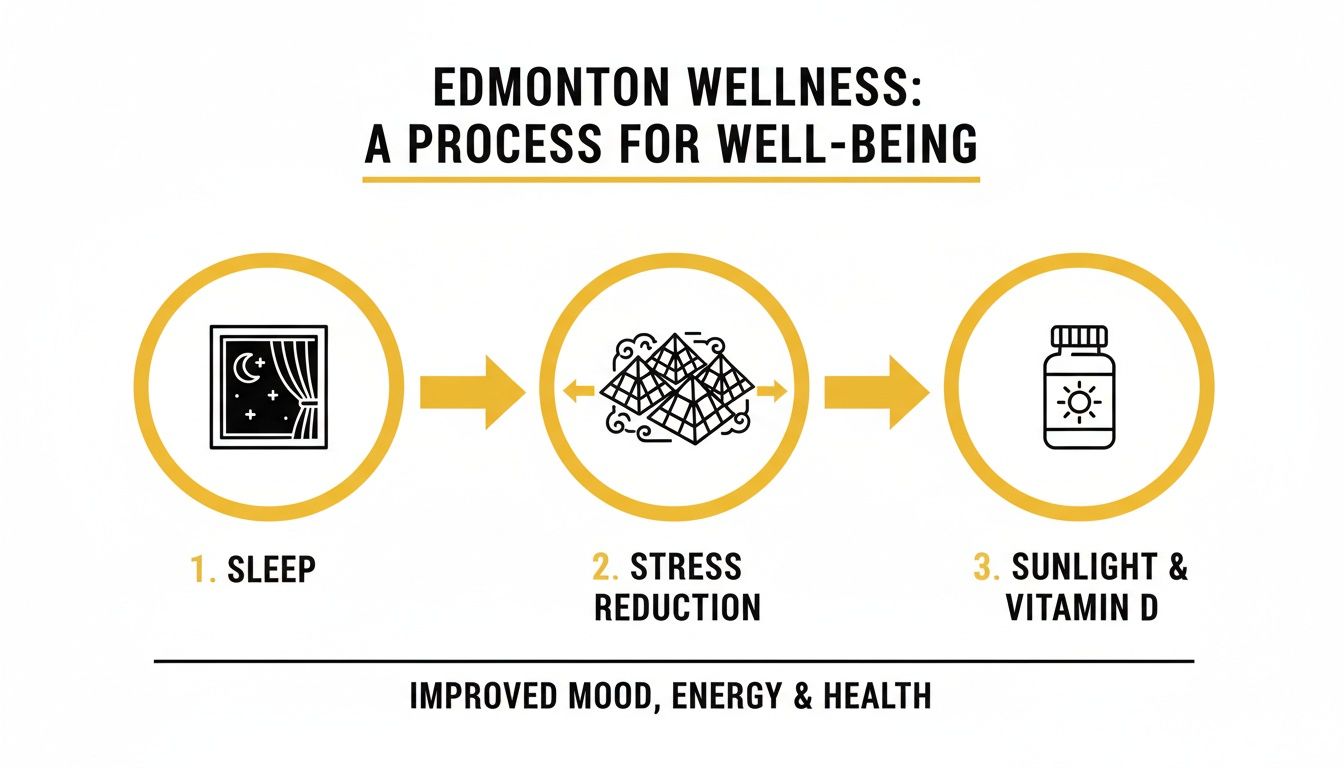
This process really highlights how interconnected our sleep, stress, and vitamin levels are—something we feel acutely in Edmonton, thanks to our extreme seasonal shifts and northern latitude.
Building Your Sustainable Toolkit
This is about creating a flexible plan that can adapt to our unique challenges. When a summer smoke season hits hard, your movement plan might have to shift from a river valley run to an indoor workout. Being prepared for these realities is key.
Since we spend so much time indoors during our long winters and unpredictable smoke seasons, managing your environment becomes crucial. You might find some real value in our guide on how to improve indoor air quality to help manage those environmental triggers.
Here’s how simple starting can look:
- Food: Add one more colourful vegetable to your dinner plate.
- Movement: Walk a single loop at Hawrelak Park once a week.
- Stress/Sleep: Put your phone away 20 minutes before you plan to sleep.
That’s it. Start small, prove to yourself you can do it, and then build from there. These are the kinds of small, consistent actions that truly reduce inflammation over the long haul.
When to Talk to a Professional
These natural strategies are powerful, but they aren't a replacement for medical care. It's important to know when it’s time to move beyond self-management and speak with a healthcare professional.
If you’re experiencing persistent joint pain and stiffness, chronic fatigue that doesn't get better with rest, unexplained digestive issues, or skin problems like eczema or psoriasis that won't clear up, it's time to book an appointment.
These can be signs that a deeper inflammatory process is at play. A doctor can run tests to measure inflammatory markers, help identify underlying causes, and create a comprehensive treatment plan that works for you.
This isn't about giving up; it’s about adding another expert to your team. You have the power to make daily choices that build a more resilient body, right here in Edmonton. Start where you are, with what you have. You’ve got this.
A Few Common Questions
With everything you’ve mentioned, where should an Edmontonian even start?
Honestly? Before you overhaul your pantry or stress about exercise, get your sleep and light exposure sorted out. It’s the single most impactful thing you can do, especially here. Our wild seasonal swings throw our internal clocks (our circadian rhythm) into chaos, which is a massive trigger for inflammation.
Start simple. Get a SAD lamp for those dark winter mornings and invest in real blackout curtains for the endless summer evenings. Nailing this foundation makes everything else so much easier.
Does this mean I have to skip the Fringe and late-night summer festivals?
Absolutely not. This is about building a resilient system, not a fragile one. The goal is consistency, not perfection.
If you know you’re going to have a late one enjoying a festival, that's fine. Just be mindful. Maybe you have a quieter, more restorative day beforehand, or you make sure to hydrate well and have a solid, anti-inflammatory meal. One late night isn't going to derail all your progress. It's what you do most of the time that counts.
Are expensive supplements really necessary to fix this?
For most of us living this far north, a good quality Vitamin D supplement from fall through winter is pretty much non-negotiable. Our latitude just doesn't give us the sun exposure we need for half the year.
Beyond that, though, focus your budget on whole foods first. A grocery cart full of colourful vegetables, high-fibre grains, and healthy fats will always give you a better return on your investment than a cabinet full of pricey, isolated nutrients in a bottle. Food is the foundation.
At Edmonton Wellness Guide, our focus is always on practical, science-backed advice that actually works for life in our city. For more personalized strategies and local resources, you can always find us at https://www.edmontonwellnessguide.com.
Related Reading
- How to Deal with Seasonal Depression in an Edmonton Winter
- What is Seasonal Affective Disorder? An Edmonton Guide to the…
- How to Manage Work Stress in Edmonton (Without Just “Surviving”…