
Let's get straight to it. For most of us living in Edmonton, the question of "what's the best vitamin D supplement?" has a pretty simple answer: a quality Vitamin D3 (the cholecalciferol kind) from a brand you trust, giving you at least 1,000 IU every day. Given our spot on the map, taking a supplement from roughly Thanksgiving to the May long weekend isn't a wellness trend; it's a basic part of staying healthy here.
Why Vitamin D Is Our Unofficial Winter Survival Tool
If you live in Edmonton, you understand winter on a deep, cellular level. We know the difference between "Edmonton cold" (anything colder than -20°C) and just regular cold. And we know that by January, the sun feels more like a vague rumour than a reality. This isn't just in our heads—our northern geography completely changes our relationship with sunlight.
For more on this, see our summer winter running guide. For more on this, see our summer winter running guide.
That brilliant, high-arcing sun that beats down on Hawrelak Park during Folk Fest is a completely different beast from the weak, low-hanging light we get in December. At 53.5°N latitude, the sun's angle is simply too low for about half the year for our skin to produce any Vitamin D. It doesn't matter how sunny it looks outside.
Our Northern Reality
Even a stunningly bright, blue-sky day in February—the kind that makes the river valley glitter with frost—isn't enough to do the job. The specific UVB rays our skin needs for Vitamin D synthesis just don't make it through the atmosphere to reach us. This puts all of us at a huge disadvantage.
The challenge for us is that even our glorious 17-hour summer days can't always bank enough Vitamin D to get us through the deep freeze. Our bodies' stores begin to dwindle as soon as the days shorten in the fall, right around the time we're all doing that last big rake in the backyard.
This isn’t about a minor dip; it's a predictable, seasonal reality for nearly everyone living here. That nagging fatigue and the low mood that often settles in with the snow—what we call "the winter blues"—is frequently tied directly to plummeting Vitamin D levels. For more on this, check out our practical guide on how to beat the winter blues.
More Than Just a Vitamin
Thinking of Vitamin D as just another pill in the cabinet misses the point entirely. Here in Edmonton, it's a non-negotiable part of our winter toolkit, as essential as a good block heater and a reliable pair of boots. It plays a critical role in:
- Immune Function: Helping our bodies fend off the endless colds and flus that circulate once we're all cooped up indoors.
- Mood Regulation: Supporting our mental well-being when the darkness feels relentless.
- Bone Health: Making sure our bodies can absorb the calcium needed to keep bones strong—especially important when navigating icy sidewalks from Strathcona to Windermere.
This isn’t about chasing some fleeting health trend. It’s about acknowledging the environment we live in and taking a simple, practical step to thrive in it. Getting your Vitamin D strategy right sets the foundation for a healthier, more energetic winter, allowing you to not just survive but actually enjoy all our city has to offer, even when it's -30°C.
Decoding Vitamin D Labels in Canadian Pharmacies
Walking into a Shoppers Drug Mart or a local health store and facing a wall of supplements can feel like a pop quiz you didn't study for. The labels all look similar, but the details matter.
For more on this, see our edmontonian supplements joint guide.
What’s the real difference between D2 and D3? Is a liquid drop better than a softgel for your family? Let's break it down in simple, practical terms.
D3 vs. D2: The Main Event
The first choice you'll face is between Vitamin D2 (ergocalciferol) and Vitamin D3 (cholecalciferol).
Think of it this way: Vitamin D3 is the key that was made specifically for the lock on your front door—it slides in and turns perfectly every time. Vitamin D2 is like a decent copy of that key; it still works, but you might have to jiggle it a bit to get the door open. Our bodies use D3 far more efficiently.
This isn't just a metaphor. Vitamin D3 is the exact form our skin produces in response to sunlight and is the clear winner for raising and maintaining your vitamin D levels. D2, which comes from plant sources like UV-exposed mushrooms, is a good option for strict vegans but is less potent and doesn't stick around in the body as long.
The global market backs this up. Vitamin D3 is expected to account for over 85% of market share by 2025 simply because the research consistently shows it’s better at supporting our health.
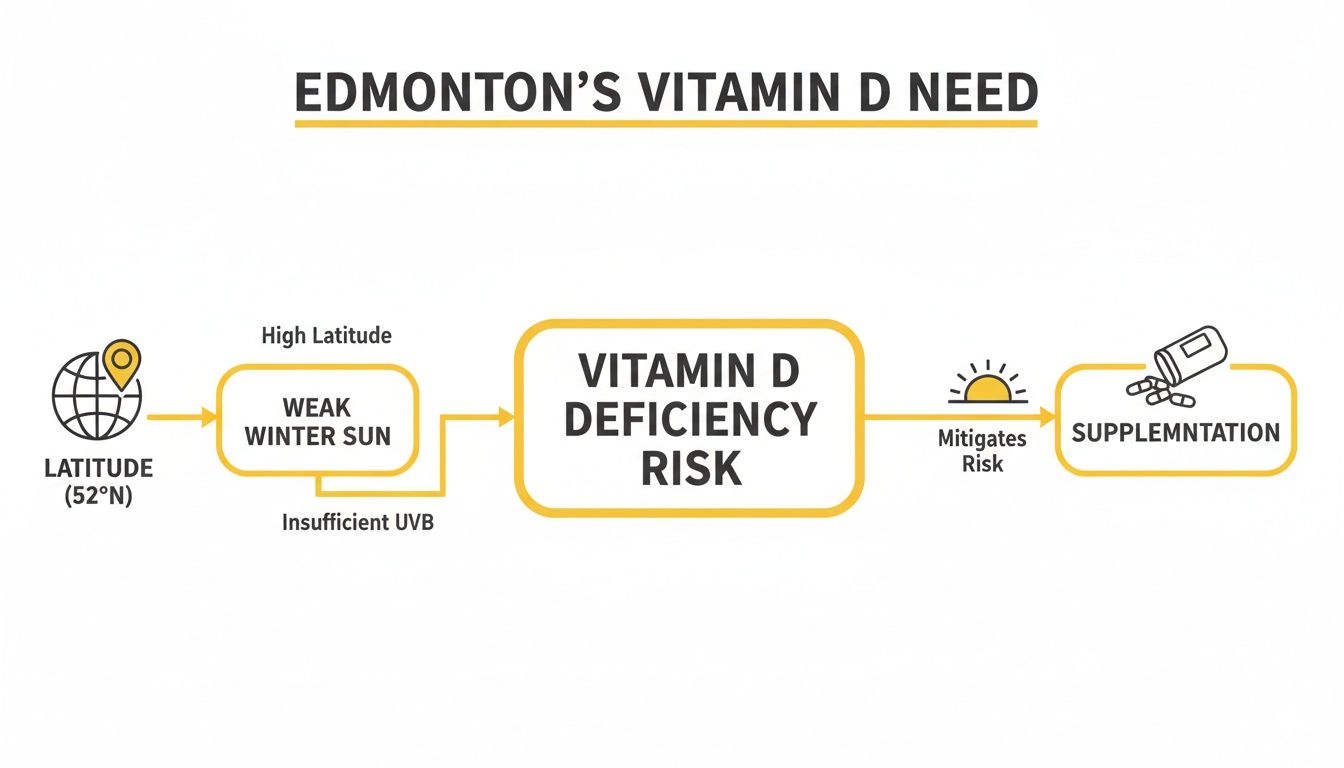
This flowchart makes our local reality clear: our high latitude and weak winter sun create a direct path to deficiency. Supplementation is the most reliable way to intercept that.
Choosing the Right Supplement Form
Beyond D2 vs. D3, you'll see different delivery methods. The "best" one often comes down to your lifestyle and personal preference. There’s no single right answer, just what works for you and your family.
The goal is consistency. Whether you live in a downtown condo or a house in Terwillegar, the most effective supplement is the one you actually remember to take every day during our long winters.
Here’s a look at the most common forms you’ll find on the shelf:
- Softgels: These are probably the most common. They are small, easy to swallow, and the vitamin is suspended in oil, which helps with absorption. They’re a great, no-fuss option for most adults.
- Liquid Drops: Fantastic for families. You can easily adjust the dose for kids and adults, and they can be added to smoothies, yogurt, or just taken directly. For anyone who dislikes swallowing pills, drops are the perfect solution.
- Gummies: A popular choice for both kids and adults who want a more pleasant experience. Just be mindful of the sugar content—read the label to make sure you're not getting more than you bargained for.
- Tablets: While tablets are the most popular supplement form in Canada overall, accounting for 31.3% of the market, they can sometimes be less effective for Vitamin D unless taken with a fatty meal. Some may also contain more binders and fillers.
To make the choice even clearer, here’s a quick comparison of everything we’ve just covered.
A Practical Comparison of D3 vs D2 and Supplement Forms
| Feature | Vitamin D3 (Cholecalciferol) | Vitamin D2 (Ergocalciferol) | Best For… |
|---|---|---|---|
| Source | Animal-based (lanolin, fish oil) | Plant-based (UV-treated yeast/mushrooms) | D3: General population. D2: Strict vegans. |
| Effectiveness | Highly effective at raising and maintaining blood levels. The body's preferred form. | Less effective and has a shorter duration of action in the body. | D3: Optimal health outcomes. |
| Common Forms | Softgels, liquid drops, tablets, gummies | Primarily tablets, often in prescription-strength doses. | Softgels/Drops: Easy absorption. Gummies: Kids or pill-averse adults. |
| Cost | Widely available and generally affordable across Canada. | Can be less common and sometimes more expensive in over-the-counter forms. | D3: Usually offers the best value for its efficacy. |
Ultimately, choosing the right type and form helps integrate supplementation into your daily routine seamlessly, which is key for maintaining healthy levels.
This is especially true for those of us trying to stay active and support our bodies through the tough winter months. Strong vitamin D levels are also linked to better absorption of calcium, which is vital for bone and joint integrity. To learn more about this connection, read our guide on the best supplements for joint health.
For more on this, see our edmontonian supplements joint guide. For more on this, see our vitamin edmonton during guide.
How Much Vitamin D Do Edmontonians Actually Need?
Let's get one thing straight: generic advice from a wellness blog based in California isn’t going to cut it here. Our reality at 53.5°N latitude is just fundamentally different. So, let’s talk practically about what makes sense for us Edmontonians.
Health Canada sets a solid baseline, recommending 600 IU (International Units) a day for most people aged 9 to 70. For adults over 70, that bumps up to 800 IU to better support bone health. But this is a bit like the city’s advice to “wear layers”—it’s a good start, but anyone who’s lived through a February cold snap knows "Edmonton cold" requires a more specific game plan.
Given our long, dark winters where our bodies make precisely zero Vitamin D from the sun, many local health professionals agree these baseline numbers are often too low for our needs. From roughly Thanksgiving to the May long weekend, we're living in a "vitamin D winter."
A Sensible Starting Dose for Edmonton Adults
For most healthy adults in Edmonton, a daily dose of 1,000 to 2,000 IU is widely considered a safe and effective place to start. This range helps offset the deep freeze and lack of sun, giving your immune system, mood, and overall health the support they need to get through the dark months.
Think of it like this: 1,000 IU is your basic winter maintenance, like plugging in your car when it hits -15°C. For many of us, bumping that up to 2,000 IU is like putting on the winter tires—it gives you an extra layer of security for those brutal stretches, like a week of -30°C when you barely see the outdoors.
A key takeaway is that you don't need a massive dose to see benefits. Starting with a conservative 1,000 IU and being consistent is far more effective than taking a huge amount sporadically.
Adjusting for Different Lifestyles and Ages
Our needs aren't one-size-fits-all. A senior living in a downtown apartment has different requirements than a toddler burning off energy at the Terwillegar Rec Centre.
- Kids and Infants: Health Canada is firm on this one: breastfed infants should get a daily supplement of 400 IU of Vitamin D. For older kids, doses can be adjusted, but drops make it easy to follow your paediatrician's advice.
- Office Workers: If your day involves a commute in the dark to an office tower where you stay from 9 to 5, your sun exposure is next to nothing, even in the shoulder seasons. A dose closer to 2,000 IU is a very reasonable strategy.
- Older Adults (50+): As we get older, our skin becomes less efficient at making Vitamin D. For seniors navigating icy sidewalks from Oliver to Mill Woods, a higher intake of 1,000 to 2,000 IU is especially important for bone density and fall prevention.
- People with Darker Skin Tones: Melanin, the pigment that gives skin its colour, naturally reduces the skin’s ability to produce Vitamin D from sun exposure. This means individuals with darker skin often need higher doses to reach the same levels as those with fairer skin.
It’s crucial to remember how much our extreme climate drives these recommendations. For a deeper dive into how our weather patterns impact daily life and health, you can read our detailed look at the Edmonton, Alberta climate.
The goal here is to land on a safe, effective dose that fits your actual life. While Health Canada sets the upper tolerable limit for adults at 4,000 IU per day, most Edmontonians won't need to get anywhere near that without a doctor's specific guidance. Starting in that 1,000-2,000 IU sweet spot is a practical way to support your well-being all winter long.
How to Choose a Quality Vitamin D Supplement in Edmonton
Alright, you know you need vitamin D, you have a rough idea of the dose, and now you’re standing in the supplement aisle. How do you actually pick a good one?
This is your practical shopping guide for finding a quality vitamin D supplement, whether you're at a big-box store in Windermere or a local health shop on Whyte Ave.
It’s one thing to face that wall of bottles, but it’s another to do it with confidence. The Canadian market is packed, with over 250 active brands of vitamin D supplements approved for sale. This isn't an accident; it’s a direct response to huge consumer demand in places like Edmonton, where our long winters make supplementation a fact of life for so many. Vitamins are the biggest slice of Canada's entire dietary supplements market, which was valued at over USD 4 billion in 2024. You can read more about the growth of the vitamin D market in Canada.
With that much choice, you need a simple way to filter out the noise.

Look for the NPN Number
Your first and most important step is to find a small, eight-digit number on the label. This is the Natural Product Number (NPN).
Think of the NPN as a government-issued license plate for supplements. Its presence means Health Canada has reviewed the product for safety, quality, and efficacy. They've checked that it actually contains what it claims to contain and that the health claims on the label are backed by real evidence.
If a supplement doesn't have an NPN, it shouldn't even be on the shelf. This is your non-negotiable baseline for quality, ensuring you're buying a legitimate, regulated product.
No NPN means no guarantee. It's the simplest and fastest way to weed out questionable products, both online and in-store.
Why Third-Party Certifications Matter
Beyond the mandatory NPN, some brands go the extra mile to prove their quality through voluntary third-party certifications. These aren't just fancy logos; they represent an extra layer of trust and transparency.
When you see one of these seals, it means an independent organization has audited the manufacturer and tested the product to verify a few key things:
- Purity: The supplement is free from harmful levels of contaminants like heavy metals or pesticides.
- Potency: The bottle contains the exact amount of Vitamin D stated on the label—no more, no less.
- Quality: The product was made according to strict manufacturing standards.
Two of the most respected certifications to look for are NSF International and USP (United States Pharmacopeia). Seeing their seal on a bottle is a strong signal that the company is committed to excellence and is willing to have its work double-checked.
Where to Buy Your Supplements in Edmonton
You can find quality supplements all over the city, and where you shop often comes down to convenience and personal preference.
- Local Health Stores: Shops along Whyte Ave or in local strip malls often have incredibly knowledgeable staff who can answer your questions. They also tend to carry unique or specialized brands you won’t find elsewhere.
- Pharmacies: Retailers like Shoppers Drug Mart or London Drugs have a wide selection of reputable, mainstream brands. Their pharmacists are also a fantastic, accessible resource for advice on dosages and potential drug interactions.
- Big-Box Stores: Places like Costco or Superstore offer great value, especially if you're buying for the whole family. You can often get larger quantities at a lower cost per unit, making it an economical choice for long-term use.
No matter where you end up, the process is the same. Turn the bottle over, find that NPN, look for a third-party seal if you can, and choose the form and dose that fits your life. This simple checklist empowers you to make a confident choice every single time.
Creating Your Year-Round Edmonton Vitamin D Strategy
Our relationship with the sun in Edmonton isn't just a casual affair—it's a dramatic, year-long saga. One minute we're soaking up 17 hours of daylight during the Fringe Festival, and the next, it feels like we're living in perpetual twilight. A static, one-size-fits-all approach to vitamin D just doesn’t cut it here.
Instead, we need a strategy that syncs with our city's unique rhythm. This means adjusting our habits with the seasons, just like we swap our trail runners for cross-country skis. It’s about building a sustainable routine that keeps your levels steady, no matter what the forecast throws at us.

Summer: The Sunshine Season (May to September)
Our summers are glorious and intense. From patio season on Whyte Ave to long evenings at Folk Fest, we pack a lot into these precious months. This is the window when our bodies can actually produce vitamin D from the sun.
- Focus on Sensible Sun: Aim for about 15-20 minutes of direct midday sun exposure on your arms and legs a few times a week without sunscreen. After that, be sure to cover up or apply sunscreen to protect your skin. A lunch break walk through Hawrelak Park is perfect for this.
- Supplementation Taper: For many of us, this is the time to ease off daily supplements. If you have underlying health conditions or your doctor has advised you to continue, stick with their plan. Otherwise, let the sun do its job.
Autumn: The Ramp-Up (September to October)
As the leaves start to turn in Mill Creek Ravine, the sun's angle drops, and so does our ability to make vitamin D. The change happens faster than you think. This is our cue to get proactive.
Think of Thanksgiving as your official deadline. By the time we're carving the turkey, the vitamin D-producing UVB rays have effectively checked out for the winter. This is the moment to restart your daily supplement routine.
Don't wait until the deep freeze hits in January. Starting your supplement early ensures your levels don't dip as the days get shorter, helping you head into winter with a full tank.
Winter: The Deep Freeze (November to April)
This is the core of our supplementation strategy. From the first real snowfall until the last of the spring mud, a daily supplement is non-negotiable for most Edmontonians.
- Be Consistent: This is when your chosen daily dose (typically 1,000-2,000 IU for adults) becomes a crucial part of your routine. Keep the bottle next to your coffee maker or toothbrush—whatever it takes to remember it every single day.
- Embrace the Outdoors (Safely): Even though we aren't making vitamin D, getting outside for a skate at the Victoria Park Oval or a walk in the river valley is vital for our mental health. That blast of cold, fresh air and bright light helps regulate our mood and sleep cycles.
Spring: The Shoulder Season
As the snow finally melts and the city comes back to life, it’s a time of transition. The sun gets stronger, but it can be unpredictable. You should continue your daily supplement until at least the May long weekend—that’s a good rule of thumb for ensuring you're covered until the summer sun is strong enough to reliably take over again.
This seasonal approach supports not just your vitamin D levels but your overall resilience. Maintaining a strong foundation is key, and if you're looking for more ways to stay healthy, you can learn how to boost immunity naturally with our other guides.
For more on this, see our boost immunity naturally guide. For more on this, see our boost immunity naturally guide.
Your Vitamin D Questions, Answered
We’ve covered a lot of ground, from why vitamin D is our unofficial winter survival tool to how to pick out a quality supplement. Still, a few practical questions always pop up in conversation. Here are the most common ones we hear about vitamin D in Edmonton, answered straight up.
Can I Really Get Enough Vitamin D From Food Alone Here?
Honestly? For us in Edmonton, it's next to impossible. It’s a nice idea in theory, but our geography completely changes the game.
While some foods are fortified with vitamin D—like milk, certain plant-based milks, and orange juice—or contain it naturally, like salmon and egg yolks, the amounts are just too low to meet our needs. This is especially true during that long stretch between fall and spring when our bodies can’t produce any of their own.
Think of it this way: you'd have to eat a big serving of fatty fish almost every single day to get close to the recommended 1,000-2,000 IU. Food sources are a fantastic supporting player, no question. They're a key part of a healthy diet that keeps you strong. But from about October to April, a supplement is the most reliable and practical way for most Edmontonians to stay healthy. For a closer look at diet, check out our guide on the best foods to boost your immune system.
What’s the Best Time of Day to Take My Vitamin D?
The most important thing is just taking it consistently. The 'best' time is simply when you'll remember it. Don’t overthink this one.
That said, vitamin D is a fat-soluble vitamin. That means your body absorbs it better if you take it with a meal containing some healthy fat—think avocado, nuts, or a drizzle of olive oil. For a lot of people, this naturally lines up with breakfast or lunch. Some prefer the morning to sync up with the body's natural rhythm of sun-related production.
The real key is to build it into a daily routine you can stick with, whether that's with your morning coffee or your midday meal. Don't stress the exact minute; just focus on taking it every day through our long, dark winters.
Do I Need to Get My Vitamin D Levels Tested by a Doctor?
For most healthy adults in Edmonton, routine testing isn't really necessary if you're taking a standard maintenance dose like 1,000-2,000 IU per day during the fall and winter. Widespread deficiency is just a well-known reality at our latitude, which makes supplementation a safe and sensible public health strategy. Our doctors know this.
However, getting your levels checked is a good idea in a few specific situations:
- You have a medical condition that affects how you absorb nutrients (like celiac or Crohn's disease).
- You are taking very high doses of vitamin D (over 4,000 IU daily) under a doctor's supervision.
- Your doctor recommends it because of bone health concerns, like osteoporosis.
- You have symptoms of a serious deficiency that don't get better with standard supplementation.
If you're curious or have concerns, just chat with your family doctor or a local pharmacist. They can help you decide if a blood test makes sense for your specific situation.
Will a Tanning Bed Help Me Make Vitamin D in the Winter?
This is a hard no. It’s a question that comes up, especially in the depths of February when we're all desperate for some light, but the answer is always the same.
While tanning beds do emit the UVB radiation that triggers vitamin D production in the skin, they are not a safe source. Health Canada, the Canadian Cancer Society, and every other major medical organization strongly advise against using them.
The huge, proven risk of skin cancer, including deadly melanoma, massively outweighs any potential vitamin benefit. It is so much safer, more effective, and a lot cheaper to simply take a high-quality supplement every day. Protect your skin and your long-term health by sticking to the supplements. Think of it this way: we wear parkas to protect ourselves from the cold; avoiding tanning beds is just another practical way we protect ourselves from a known danger.
At Edmonton Wellness Guide, our goal is to provide you with practical, evidence-based health information that makes sense for our city. We're here to help you build sustainable habits that support your well-being through every Edmonton season. Learn more about our approach at https://www.edmontonwellnessguide.com.
Related Reading
- How to Reduce Inflammation Naturally: An Edmonton Guide
- How to Stay Active During Edmonton’s Winter Smoke Season: A…
- Winter Light: A Practical Guide to Managing SAD in Edmonton