
When you're looking for the best probiotics for gut health in Canada, it’s not just about grabbing the first bottle you see at the drugstore. It means finding specific strains—like Lactobacillus and Bifidobacterium—that are backed by real clinical research and have a Health Canada NPN number.
For us here in Edmonton, there's another layer to it. It means picking a product that can actually survive our climate's wild swings and support the unique demands our northern lifestyle puts on our bodies. Let's be honest, -30°C and 17-hour summer days ask a lot of us, and our guts feel it first.
For more on this, see our prevent running injuries guide. For more on this, see our prevent running injuries guide.
Your Guide to Gut Health in Edmonton

Living in Edmonton is a life of extremes, and our bodies are just trying to keep up. We swing from those glorious, endless summer days packed with Folk Fest and Fringe shows straight into the deep freeze of a -30°C winter, where comfort food feels less like a choice and more like a survival strategy. Our guts are often the first to feel the strain of these dramatic shifts.
This guide isn't about the generic wellness advice you can find anywhere. It's a practical, no-nonsense look at probiotics, built specifically for us. We'll dig into why our northern climate really does demand a smarter approach to gut health.
Why Our City Is Different
Our unique environment throws some specific curveballs at our gut microbiome—that complex community of bacteria living in our digestive tract. Things that are just a normal part of life here can easily knock that delicate system off-kilter:
- Seasonal Extremes: The sudden shift from endless summer light to long, dark winters can mess with our circadian rhythms, impacting not just our sleep but our digestion and mood, too. Hello, SAD.
- Dietary Changes: It's natural to gravitate toward heavier, less varied foods when the "Edmonton cold" hits. While a bowl of stew is fantastic, this shift can starve the beneficial bacteria that thrive on fibre from fresh, diverse produce.
- Environmental Factors: From summer wildfire smoke settling in the river valley to the inevitable flu season that rips through downtown offices, our immune systems are constantly on high alert. A healthy, resilient gut is our first line of defence.
This guide is all about building resilience that works from the muddy spring thaw right through to the first hard frost. We'll cut through the marketing hype to figure out what actually helps, how to choose the right products in Canada, and how to support your gut, whether you’re training in the river valley or just trying to feel your best during another long Edmonton winter.
Our goal is to give you real, actionable advice that fits into your life right here. You can explore more strategies for local well-being by checking out our comprehensive guide to health and wellness in Edmonton. It’s all about finding what works for you, in your city.
For more on this, see our prevent seasonal wellness guide. For more on this, see our wellness edmonton alberta guide. For more on this, see our health wellness edmonton guide. For more on this, see our finding footing guide. For more on this, see our finding spin class guide. For more on this, see our wellness edmonton alberta guide. For more on this, see our health wellness edmonton guide. For more on this, see our finding footing guide.
What Are Probiotics and Why They Matter Here
Let’s think of our gut as the LRT system for a moment. It's a massive, sprawling network that, when running smoothly, keeps the entire city moving. Probiotics are the friendly operators and maintenance crews keeping everything on schedule, day in and day out.
Simply put, probiotics are beneficial live bacteria that help balance your internal ecosystem, known as the gut microbiome. Here in Edmonton, that balance is constantly being put to the test. Our northern reality means we face unique challenges that directly impact gut health, often in ways we don't even realize.
Our Climate and Our Guts
The link between our environment and our digestion is stronger than you might think. We see it every year. The shift from those endless summer evenings to the dark, short days of November isn't just a mood killer; it's a gut-health disruptor.
- Winter's Toll: When the sun disappears, our Vitamin D levels can plummet. This is tied not just to Seasonal Affective Disorder (SAD) but also to gut inflammation and the diversity of our microbiome.
- Dietary Shifts: It’s instinct to reach for hearty, heavy comfort foods when it’s -25°C outside. While delicious, this often means less variety and fibre, essentially starving the good bacteria that keep our digestive system resilient.
- Immune System Overload: Between the wildfire smoke that settles into the river valley in the summer and the inevitable flu season that hits offices downtown, our immune systems are constantly on defence.
A well-balanced gut is foundational to a strong immune response. Approximately 70% of your immune system resides in your gut, so keeping it healthy is one of the most practical things we can do to stay well through our city’s demanding seasons.
More Than Just Digestion
Thinking of probiotics as just a fix for bloating is like thinking the High Level Bridge is only for cars. A healthy gut microbiome influences nearly every aspect of our well-being, which is crucial for handling the pressures of our city's lifestyle.
A balanced gut helps support everything from mental clarity for those busy work weeks to regulating mood when the winter drags on. It's a key player in how our bodies manage inflammation, absorb nutrients, and maintain energy levels. For those of us looking for practical ways to feel our best, understanding how to boost immunity naturally often starts right here, in our gut.
Ultimately, these tiny allies work behind the scenes to help us build the resilience needed to not just survive, but thrive, through everything an Edmonton year throws at us.
How to Choose the Right Probiotic Strains
Walking into a health food store in Windermere or along Whyte Ave and staring at the wall of probiotics is overwhelming. It’s tempting to just grab the one with the nicest label, but that’s like wearing your heaviest parka for a run in Hawrelak Park in May—it’s not the right tool for the job. Not all probiotics are created equal, and different strains perform very different jobs inside our bodies.
Think of your gut microbiome as a specialized community. Probiotic strains are like the skilled professionals you hire to get specific work done. You wouldn't call a plumber to fix your roof, and you shouldn’t grab a generic, one-size-fits-all probiotic blend hoping it’ll solve a targeted issue. The whole game is matching the right strain to your specific goal, whether that’s calming your digestion after too much festival food or shoring up your immune system before the office cold makes its rounds in January.
The Major Players in Gut Health
While hundreds of strains exist, a few key players show up again and again in solid research and are widely available across Canada. These are the names you’ll see most often on labels, and they form the foundation of most effective probiotic supplements. Getting to know them is the first step in making a smart choice.
Here are a few of the most important and well-studied groups:
- Lactobacillus Strains: These are probably the most famous of the bunch. They mostly set up shop in the small intestine and are fantastic for general digestive health, helping us break down food and absorb nutrients more effectively.
- Bifidobacterium Strains: This group prefers to hang out in the large intestine. They’re heavy lifters for our immune system, helping to regulate inflammation and producing important compounds that keep the gut lining strong and healthy.
- Saccharomyces boulardii: This one is actually a beneficial yeast, not a bacterium. It’s incredibly resilient and is often the go-to recommendation during or after antibiotic use to help prevent digestive chaos and restore balance.
This is a great breakdown of the core benefits a well-balanced gut microbiome can offer.

As you can see, a healthy gut is central to so much more than just digestion—it influences our immunity and even our mood, all of which are critical for navigating Edmonton's demanding seasons.
Matching Strains to Your Health Goals
So, how do we put this into practice? Let’s get specific. Our lives here have distinct rhythms and challenges, and we can choose our probiotics to match. The most effective way to cut through the noise is to start with your primary goal. This alone will help you find the best probiotics for gut health in Canada that will actually work for you.
Don't get distracted by the highest CFU count or the fanciest packaging. The most important factor is strain specificity. Look for products that list the full strain name, including the letters and numbers at the end (like Lactobacillus rhamnosus GG), as this indicates you're getting the exact strain used in clinical research.
To make it even easier, this table connects some common health concerns for Edmontonians with the probiotic strains that science suggests are most effective for them.
Matching Probiotic Strains to Your Health Goals
| Health Goal | Key Probiotic Strains to Look For | How It Helps |
|---|---|---|
| General Digestion & Bloating | Lactobacillus acidophilus, Lactobacillus plantarum | Helps manage the discomfort from heavier winter diets and supports overall digestive ease year-round. |
| Immune System Support | Bifidobacterium lactis, Lactobacillus rhamnosus GG | A great way to strengthen your defences during flu season and navigate the airborne irritants of summer smoke. |
| Antibiotic Recovery | Saccharomyces boulardii, Lactobacillus rhamnosus GG | Crucial for helping your gut microbiome bounce back after a course of antibiotics, which can be harsh on your system. |
| Mood and Stress | Lactobacillus helvicus, Bifidobacterium longum | Supports the gut-brain connection, which can be particularly helpful for managing stress and the winter blues (SAD). |
By focusing on your main objective first, you can read labels with confidence and choose a product that has a clear purpose. This targeted approach ensures you’re not just taking another supplement, but actively supporting your body’s unique needs through our city’s equally unique challenges.
Decoding Probiotic Labels in Canada
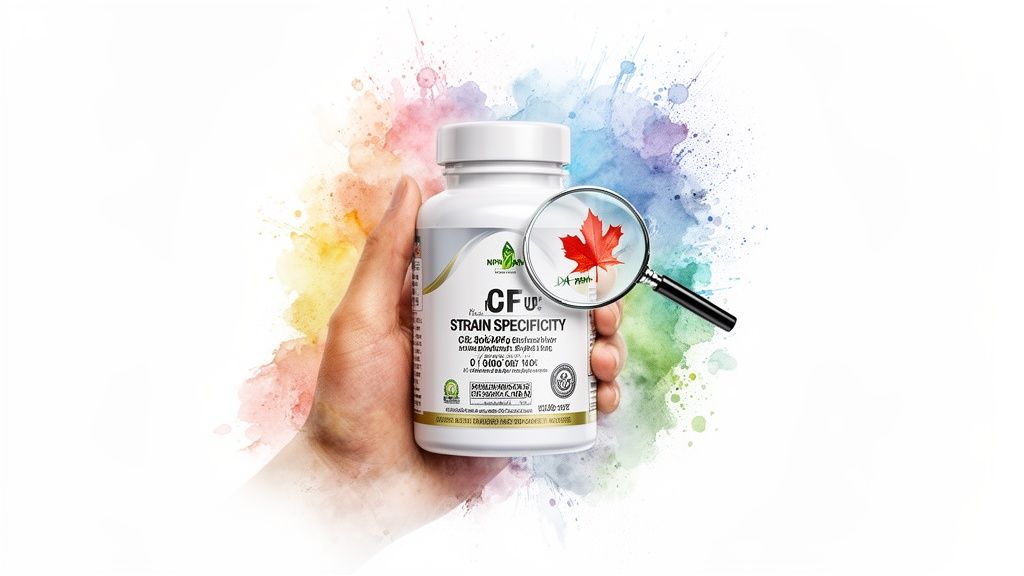
Trying to read a probiotic label can feel like deciphering a secret code. Between the acronyms, the massive numbers, and the scientific names, it’s easy to get lost. But figuring out these labels is the key to getting what you pay for—and finding a product that actually works, not just one that sits on your shelf.
This is your hands-on guide to cracking that code. We’ll break down the most important terms so you can walk down the supplement aisle with confidence, knowing exactly what to look for.
CFU Is Not the Whole Story
One of the first things you'll see splashed across a label is CFU, which stands for Colony Forming Units. This number tells you how many live, viable bacteria are in each dose. It’s tempting to think that bigger is always better, but that’s one of the biggest misconceptions out there.
Think of it this way: sending a dozen random people to fix a complex electrical problem won't be as effective as sending one certified electrician. The same is true for probiotics. It’s far more important to have the right dose of the right strain for your specific goal than to just grab the bottle with the highest CFU count.
For general gut maintenance, a product with 10 to 20 billion CFU is often a great starting point.
Strain Specificity Is Everything
This is where the real value lies. A label that just says "Lactobacillus acidophilus" is okay, but a great label will give you the full strain designation, like Lactobacillus rhamnosus GG. Those extra letters and numbers are your proof that the product contains the exact, specific strain that has been researched in clinical studies.
Without a specific strain number, you have no guarantee you're getting the well-researched version of that bacteria. It’s the difference between buying a generic "car" and a specific make and model with a proven safety record.
The Edmonton Cold Weather Test
Here's something most guides won't mention, but it's critical for us. A probiotic that freezes solid on a delivery truck during a -40°C cold snap is essentially useless. Extreme cold can kill live bacteria just as easily as extreme heat.
This is why shelf-stable or freeze-dried formulations are often a smarter, more reliable choice for anyone living in our climate. These products are designed to withstand temperature swings, ensuring the bacteria are still alive and kicking by the time you take them.
Always look for a "guaranteed potency" statement. This is the manufacturer's promise that the listed CFU count will be viable until the expiry date, not just on the day it was made. It's a crucial mark of quality for anyone buying the best probiotics for gut health in Canada.
Your Assurance of Safety and Quality
Finally, look for one simple thing on every label: an NPN, or Natural Product Number. This eight-digit number is your assurance that Health Canada has reviewed the product for safety, quality, and efficacy. If a probiotic doesn't have an NPN, it's not being sold legally in Canada.
This simple check helps you avoid sketchy products and ensures you’re getting a supplement that meets our country’s high standards.
It’s also worth remembering that our long, dark winters impact more than just our guts. As you focus on probiotics, it’s a good time to consider your Vitamin D levels, too. You can learn more by reading our guide to the best vitamin D supplements in Canada.
Integrating Probiotics Into Your Edmonton Life
Choosing the right probiotic is a huge first step, but the real work starts now. For a probiotic to actually help, you have to make it a seamless part of your daily routine—something that feels as natural as your morning coffee, not just another chore on an endless to-do list.
This means thinking seasonally. Life in Edmonton—and by extension, our gut health—is a completely different beast in January than it is in July. A smart strategy acknowledges these massive shifts and adapts, making gut support feel effortless whether you're layering up for a frigid walk or packing for a weekend at Folk Fest.
A Year-Round Edmonton Strategy
Our city’s entire rhythm is dictated by the seasons, each bringing unique challenges and opportunities for our well-being. Your probiotic routine should reflect that reality.
- Winter (-30°C and Dark): When the deep freeze sets in, we need to double down on support. This is the perfect time to pair your daily probiotic with a good Vitamin D supplement. The combination is a powerhouse for supporting your immune system and can help take the edge off those persistent winter blues. It’s a simple, practical way to build resilience when the sun feels like a distant memory.
- Summer (Festivals and 17-Hour Days): From the Fringe to Heritage Fest, summer in Edmonton is wonderfully chaotic. It also means a steady diet of festival food and completely thrown-off schedules. A consistent probiotic can be your gut’s best friend here, helping manage the digestive fallout from all those green onion cakes and keeping things regular when your routine is anything but.
Finding Probiotic Foods in the City
While supplements are fantastic tools, you can also get a steady dose of beneficial bacteria directly from food. Thankfully, you don't have to look far; Edmonton has plenty of great options, from big-box stores to our favourite local spots.
You’ve probably seen the growing selection of probiotic yogurts, kefirs, and even sodas at places like Save-On-Foods in Windermere or the Italian Centre on the south side. These "functional foods" can be an easy, delicious way to top up your good bacteria.
The rise in popularity is impossible to miss. In Canada, the market for probiotic and prebiotic sodas hit USD 20.7 million in revenue, with probiotics making up over 60% of that. This trend shows just how many of us are looking for simple ways to support our gut health, especially during our long winters when digestion can feel sluggish. You can discover more insights about this growing market on grandviewresearch.com.
But there's a trade-off. While convenient, many of these products are loaded with added sugars, which can counteract some of the benefits. Always, always check the label.
If you're looking for a therapeutic dose to address a specific issue, a targeted supplement is still your most reliable bet. Think of probiotic foods as a great tool for daily maintenance. And if you're curious about other ways to support your health through diet, check out our guide on the best foods to boost your immune system. The key is finding a balance that works for your life and your health goals.
Finding Local Foods and Professional Support
While supplements are an excellent tool, true gut resilience really starts with the food on our plates. Fortunately, Edmonton is brimming with incredible local makers creating probiotic-rich fermented foods that can support your gut health the old-fashioned way.
A weekend trip to the Strathcona Farmers' Market or any of our great community markets will introduce you to artisans crafting everything from tangy sauerkraut and spicy kimchi to bubbly kombucha. These aren't just trendy foods; they're packed with live cultures that add some much-needed diversity to your gut microbiome.
Working them into your routine doesn't have to be a big production. A splash of kefir in your morning smoothie, a forkful of sauerkraut alongside dinner, or some kimchi tossed into a weeknight stir-fry are all simple, effective ways to get more beneficial bacteria into your diet.
Where to Find Probiotic-Rich Foods
- Farmers' Markets: Places like the Old Strathcona Farmers' Market and the Bountiful Farmers' Market are hubs for local producers of fermented goods.
- Local Grocers: Shops like the Italian Centre and Blush Lane Organic Market often carry locally made kombucha, kefir, and kimchi.
- Dining Out: Many local restaurants are now working fermented foods into their dishes. Exploring some of the best healthy food restaurants in Edmonton can be a delicious way to support your gut.
The interest in gut health isn't just a fad. The Canada probiotics market is seeing strong growth, driven by a greater awareness of digestive wellness. With a 30% lifetime risk of IBS for Canadians, this is a topic that hits close to home, especially here in Edmonton where long winters can amplify digestive stress. This trend is expected to continue, with more personalized options becoming available to meet our local needs for everything from winter immunity to smoke-season resilience. You can read the full market report on researchandmarkets.com.
When You Need More Guidance
Sometimes, food and supplements just aren't cutting it, and you need personalized, professional advice. Navigating gut health can get complicated, and working with an expert who understands our local context can make all the difference.
A knowledgeable professional can help you connect the dots between a supplement, your diet, and a long-term wellness strategy that actually fits your life here in Edmonton. They can offer targeted testing and recommendations that go beyond general advice.
If you're looking for that next level of support, consider connecting with a registered dietitian or a naturopathic doctor who specializes in digestive health. They are trained to provide evidence-based guidance tailored to your specific situation, helping you create a sustainable plan for feeling your best year-round.
Your Probiotic Questions Answered
We've covered a lot of ground, from decoding labels to finding local ferments at the Strathcona Market. Still, a few practical questions always seem to pop up. Let's tackle some of the most common ones we hear from fellow Edmontonians.
When Is the Best Time of Day to Take a Probiotic?
Honestly? The best time is whenever you'll actually remember to take it.
Some studies suggest that taking probiotics 15-30 minutes before a meal might give the bacteria a slightly better chance of surviving stomach acid. But the truth is, consistency is far more important than perfect timing. Whether you make it part of your morning coffee routine or take it right before bed, building a sustainable habit is the real goal. This is especially true during our long winters, when sticking to any routine can feel like a win.
How Long Does It Take to Feel the Effects?
This really depends on the person and what you're hoping to achieve. Some people notice improvements in things like bloating or digestive regularity within a few days to a week. When that happens, it’s a great feeling.
For more systemic benefits, like supporting your immune system or even influencing your mood, you need to play the long game. Be patient. Give it at least four to eight weeks of consistent use for the new bacteria to establish themselves and create a noticeable shift in your gut. This isn't a quick fix; it's a long-term strategy for building resilience.
Think of it like training for a run in the river valley. You don't see massive progress after one day, but consistent effort over a month builds strength and endurance that you can actually feel. Probiotics work the same way for your internal ecosystem.
Can I Get Enough Probiotics from Food Alone?
Fermented foods like yogurt, kimchi, and kefir are fantastic. They should absolutely be a regular part of your diet for daily maintenance and adding diversity to your gut.
But if you're trying to target a specific health issue—say, managing IBS symptoms or recovering after a course of antibiotics—a supplement is almost always more effective. Supplements deliver a high, targeted dose of specific, clinically-studied strains that you simply can't guarantee you're getting from food.
The best approach often involves both. Use probiotic-rich foods as your foundational support. Think of a high-quality supplement as therapeutic support for when you need that extra boost to feel your best. Finding the best probiotics for gut health in Canada means choosing the right tool for what your body needs right now.
At the Edmonton Wellness Guide, we're committed to providing practical, science-backed insights that help you navigate health and well-being in our unique city. For more locally focused advice and personalized plans, visit us at https://www.edmontonwellnessguide.com.
Related Reading
- Finding the Best Gyms in Edmonton: A Local’s Guide for 2025
- Year-Round Fitness Exercises for Seniors in Edmonton
- A Local’s Guide to Weather in Edmonton in March